You signed up for a content tool, but the drafts still need heavy editing before they go live. That gap between output and publishable copy is usually what sends bloggers and agencies hunting for something better.
This article breaks down what to check in a Trolly.ai alternative, from output quality to pricing and workflow fit, then compares nine options, including Autoblogging.ai. By the end you will know which tool matches your volume, budget, and editing tolerance.
What to Look For in Trolly.ai Alternatives for Automated Content Generation
Evaluating Trolly.ai alternatives requires a clear framework that goes beyond surface-level features and considers how each tool performs in real-world content workflows. Anyone can claim to generate articles with AI, but the gap between a usable draft and a publishable piece often comes down to a handful of measurable qualities.
The goal here is simple: help you tell the difference between a mediocre automated content generator and one that genuinely saves time while improving output. A tool that produces fluent text but needs heavy editing may cost more hours than it saves. A tool with a low sticker price but rigid credit limits can quietly become expensive at scale.
Throughout this roundup, every alternative is assessed against the same criteria: feature depth, pricing transparency, and output quality. That consistency makes it easier to compare very different products, from full content creation platforms to lightweight AI copywriters, on equal footing.
Keep three practical questions in mind as you read. Does the tool fit the type of content you publish most often? Does its pricing model match your expected volume? And can you trust the output enough to publish it with light editing rather than a full rewrite?
Key Features, Pricing, and Output Quality Compared
When comparing automated content generation tools, three dimensions matter most: the range and depth of features, the transparency and scalability of pricing, and the factual accuracy and readability of the output. Each one deserves a closer look before you commit budget or workflow time.
Features determine how much of your content process a tool can actually absorb. Bulk generation matters if you publish at volume, while template libraries and workflow automation matter more for teams producing repeatable formats. SEO integrations, multi-language support, and tone of voice controls separate tools built for serious content operations from basic text spinners.
- Bulk generation: the ability to produce many drafts from a keyword list or spreadsheet without manual prompting.
- Template libraries: prebuilt structures for blog posts, product descriptions, email newsletters, ad copy, and social media captions.
- SEO integrations: connections to keyword data or SEO content briefs so drafts match what users are searching for.
- Multi-language support: useful for localized campaigns, though quality varies widely by language.
- Brand voice and tone controls: settings that keep output consistent across writers and campaigns.
Good looks like a tool that turns a keyword into a structured, editable draft in one step. Bad looks like a generator that requires ten prompts to produce one usable section.
Pricing models generally fall into two camps: credit systems and unlimited or subscription-based plans. Credit systems can work well for occasional use, but costs scale with volume, and heavy publishers often outgrow them quickly. Unlimited plans offer predictable budgeting, though fair-use limits and feature gating are worth checking. The key question is how cost behaves as your output doubles or triples.
Output quality is where most tools reveal their limits. Look for coherence across long-form writing, factual consistency, controllable tone, and low plagiarism risk. Research suggests that even strong large language models can drift or state incorrect details, so a built-in plagiarism checker and a grammar checker remain practical safeguards. A good sign is output that needs light editing. A bad sign is text that reads fluently but says nothing accurate or specific.
Judged together, these criteria explain why two tools with similar feature lists can perform very differently in daily use. Feature depth sets the ceiling, pricing sets the long-term cost, and output quality decides how much of your time the tool truly returns.
1. Autoblogging.ai - Best Overall
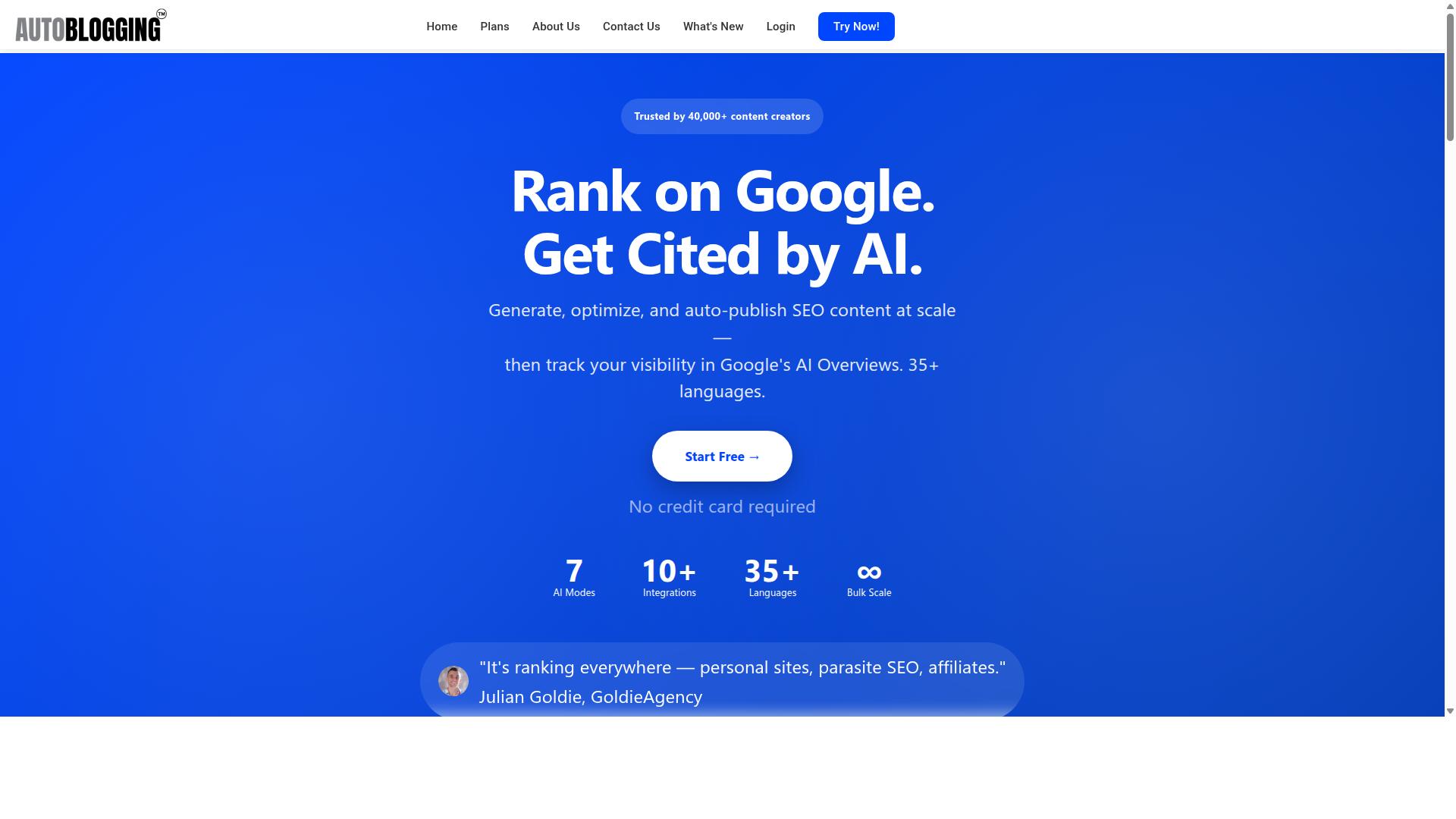
Autoblogging.ai earns the top spot for its combination of advanced AI modes, scalable pricing, and a proven track record with over 40,000 content creators.
Among the many Trolly.ai alternatives available for automated content generation, Autoblogging.ai stands apart because it covers the full range of needs, from a casual blogger publishing one post at a time to an agency producing content at volume. It holds a 4.9 average rating and has generated more than 1M+ articles.
The platform supports 35+ languages and 35+ integrations, which gives it genuine global reach rather than a single-market focus. It also includes a human proofreader on all plans and one-click WordPress publishing, two features that matter for anyone running a live content operation.
What follows is a closer look at the specific modes and pricing tiers that justify this ranking.
Modes, Pricing, and Why It Tops the List
Autoblogging.ai offers a range of AI modes, from a free Quick Mode for single articles to a Godlike Mode that performs SERP competitor analysis and extracts LSI keywords and knowledge graphs.
Quick Mode is available at no cost and supports both single and wizard workflows, making it a sensible entry point for testing output quality. Godlike Mode goes deeper, analyzing competing pages on the SERP and pulling in semantic signals such as LSI keywords and knowledge graph data. Bulk Generation handles up to 500 articles via CSV, which suits agencies and publishers managing large content calendars.
The pricing structure scales alongside those needs:
- Starter $19 for 40 credits
- Regular $49 for 120 credits
- Standard $99 for 300 credits
- Gold $179 for 600 credits
- Premium $249 for 1,000 credits
- Enterprise $999 for 5,000 credits
Annual plans reduce the effective monthly rate. For example, Starter drops to $12/mo ($148/year) and Enterprise to $649/mo ($7,792/year). New accounts receive 10 free credits per month with no credit card required, and additional credits can be purchased as needed.
Two details make the pricing more forgiving than most AI writing tools. First, credits roll over, so unused capacity is not lost at the end of a billing cycle. Second, 24/7 support is available across plans, which matters when content production runs on a deadline.
Add in a 21-point SEO audit, featured snippet optimization, and new features shipped weekly, and the combination of breadth, pricing flexibility, and reliability is what puts Autoblogging.ai at the top of this list.
2. Article Forge

Article Forge is a well-known automated content generator that focuses on producing long-form articles with minimal input. Users typically provide a keyword or short topic phrase, and the platform returns a complete draft without requiring an outline or manual research.
It sits in the same broad category as other AI writing tools built for automated content generation, where the main appeal is speed and volume rather than fine-grained editorial control.
Because the tool leans on large language models to expand a single prompt into a full piece, it is often used for first drafts, topic coverage, and bulk publishing workflows where a writer or editor reviews the output afterward.
Article Forge's core workflow is straightforward. A user enters a keyword, the system generates a structured article, and the result can be exported for editing or publishing. Several settings let users influence length and structure before generation begins.
Key characteristics commonly associated with this type of blog post generator include:
- Article creation from a single keyword or short phrase
- Long-form output rather than short snippets
- Automated structuring with headings and paragraphs
- Support for bulk generation in some workflows
- Export options for use in a CMS or editing tool
These traits make it useful for long-form writing tasks where a rough draft is the goal, not a finished, publish-ready asset.
Pricing for tools in this category is usually subscription-based, often with tiered plans tied to word volume or article count. The exact figures for Article Forge are not covered in the sources reviewed here, so readers should check the vendor's current pricing page directly before committing.
Typical output quality is best described as serviceable for a draft. The writing tends to be coherent and readable, but factual accuracy can vary, and claims may need verification before publication.
Strengths often cited for this kind of tool include:
- Speed, generating a draft in a fraction of the time manual writing takes
- Length, producing full articles rather than short-form copy
- Low effort at the input stage, since a keyword is often enough
- Usefulness for covering many topics quickly
Limitations are worth weighing just as carefully. Advanced SEO content features such as detailed keyword optimization, internal linking suggestions, or SERP-driven briefs are generally not the focus of this type of generator.
Editors also report that tone and brand voice can be inconsistent across outputs, and that paragraphs sometimes repeat ideas. For marketing copy, email newsletters, or social media captions, a tool built around long articles may be less suitable than a dedicated AI copywriter.
A practical approach is to treat Article Forge as a drafting layer. Generate the piece, then run it through a grammar checker, a plagiarism checker, and a fact review before anything goes live. Pairing it with a paraphrasing tool can also help smooth repetitive phrasing and align the text with a consistent tone of voice.
For teams producing high volumes of SEO content, that combination of fast generation and human review tends to work better than publishing raw output. It keeps the efficiency gains while limiting the risk of inaccurate or thin material reaching readers.
3. AutoPost

AutoPost is designed for bloggers who want to automate the publishing of AI-generated content directly to their WordPress sites. Rather than writing and uploading posts by hand, users configure the tool once and let it handle generation and delivery on a schedule. It sits in the same category as Trolly.ai and other automated content generation platforms, though its focus leans toward publishing rather than pure writing assistance.
The tool generally works by connecting to a large language model through an API key that the user supplies. In most setups, that means bringing your own OpenAI credentials rather than relying on a bundled subscription. This keeps the software itself lean, but it also means output quality depends heavily on the model you choose and how well you tune your prompts.
WordPress access is typically granted through an application password, a native WordPress feature that lets external tools post without exposing your main login. Once connected, AutoPost can push finished articles straight into your site as drafts or live posts, depending on your settings.
Core Features and Workflow
AutoPost centers on a small set of practical controls. Users define target keywords, adjust post settings such as length and structure, and write AI prompts that shape the tone and angle of each article. The tool then generates content and publishes it on a schedule you set.
Common capabilities in this category include:
- Scheduled posting at set intervals, so a site keeps publishing without manual effort
- Direct WordPress integration via application password authentication
- Keyword targeting to steer topics and on-page SEO
- Custom AI prompts for controlling structure, tone, and format
- Support for your own API key, which gives flexibility over model choice
Because the workflow is largely hands-off, AutoPost tends to suit marketers, agencies, and bloggers who are scaling content across one or more sites. The trade-off is that customization is limited compared with full AI writing suites. There is little in the way of advanced editing, brand voice training, or multi-step review before publishing.
Pricing and Output Quality
Pricing for tools like AutoPost varies, and some options in this space offer free trials so users can evaluate output before committing. Because many of these tools rely on your own API key, the real cost often includes usage fees charged by the AI provider on top of any software subscription. It is worth checking both layers before choosing a plan.
Output quality is closely tied to the underlying model and your prompts. A well-crafted prompt with a capable model can produce readable, on-topic articles. A vague prompt tends to produce generic text that needs editing. Since results can vary, treating AutoPost as a first-draft engine rather than a finished-content machine is a reasonable approach.
One practical caution comes from user discussions: some bloggers warn against running fully automated posting on important or high-value websites. Search engines and readers both reward content that shows genuine expertise, so reviewing and refining AI output before it goes live is generally the safer path.
Limitations to Consider
AutoPost's reliance on external AI services is its most notable constraint. If your API key expires, your provider changes its terms, or you hit a usage limit, publishing can stall. There is no built-in fallback model in most setups, so continuity depends on services you do not control.
The tool also offers less advanced customization than broader content creation platforms. Features like detailed brand voice controls, template libraries, or integrated grammar and plagiarism checks are often absent or minimal. For teams that need fine-grained editorial control, that gap matters.
Finally, automated posting works best as part of a wider content strategy. Pairing scheduled AI drafts with human editing, keyword research, and internal linking tends to produce better results than publishing raw output at volume. AutoPost handles the repetitive publishing work well, but it does not replace editorial judgment.
4. RankYak
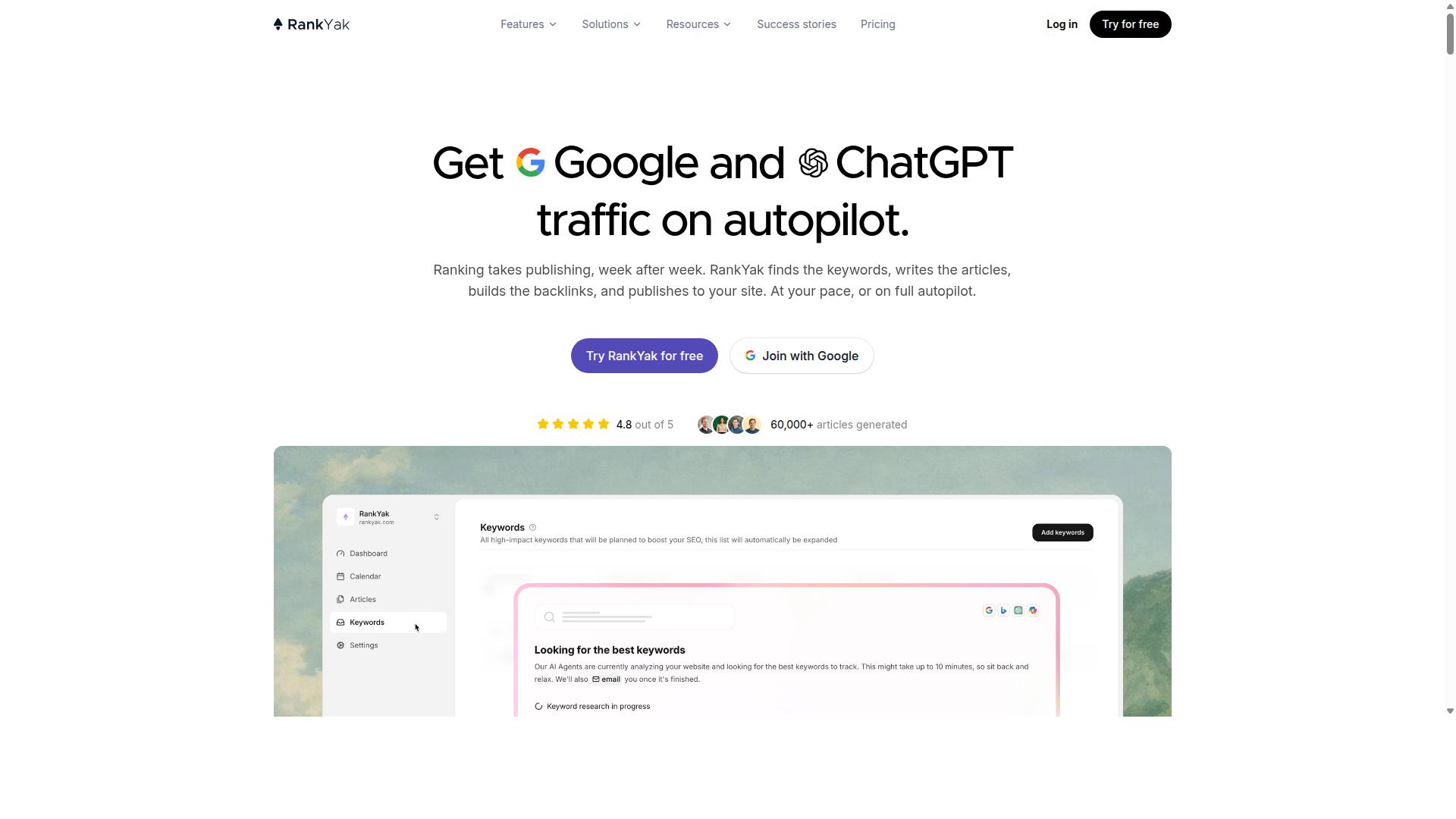
RankYak positions itself as an SEO-focused content automation tool that generates articles optimized for search engines. Rather than acting as a general-purpose AI writer, it bundles keyword research, content planning, and publishing into a single workflow aimed at teams that want organic traffic without assembling a stack of separate tools.
The platform is built around a keyword discovery engine that feeds directly into a content plan. From there, users move into article generation, where target keywords and search intent shape the draft rather than being bolted on afterward. This tight loop between research and writing is the core of its SEO content pitch.
RankYak also markets itself with the promise of getting "Google and ChatGPT traffic on autopilot," reflecting the growing expectation that content should be structured to surface in both traditional search and AI-generated answers. The site claims users can generate a first article within 15 minutes, and a free trial is available for evaluation.
Its feature set extends beyond drafting. Notable capabilities include:
- Site Guard, which identifies pages losing clicks and helps fix them
- A backlink exchange component for link acquisition
- Copilot and an MCP server for assisted and integrated workflows
- Integrations that connect the platform to existing publishing setups
RankYak targets a broad range of users, with packaged solutions for agencies, SaaS companies, ecommerce stores, startups, and local businesses. That segmentation suggests the tool is designed to scale from single-site owners to teams managing multiple client properties, though the depth of each solution varies by tier.
On pricing, RankYak does not publish clear figures on the pages reviewed here, so prospective buyers should confirm current plans directly. The free trial is the most reliable way to gauge whether output quality matches a given use case before committing.
Output quality is best described as competent and SEO-aligned rather than stylistically distinctive. Articles tend to follow structured, keyword-aware formats suited to informational queries, which works well for volume publishing but may require editing for brand voice or nuanced topics. The Site Guard feature is a genuine differentiator, since most AI writing tools stop at generation and leave performance monitoring to separate platforms.
Drawbacks are modest but worth noting. The SEO-first framing means less flexibility for short-form copy, social media captions, or ad copy compared with broader content creation platforms. Teams wanting a single tool for every format may find RankYak narrow, while those focused purely on search-driven blog content will find the focus useful.
5. theStacc
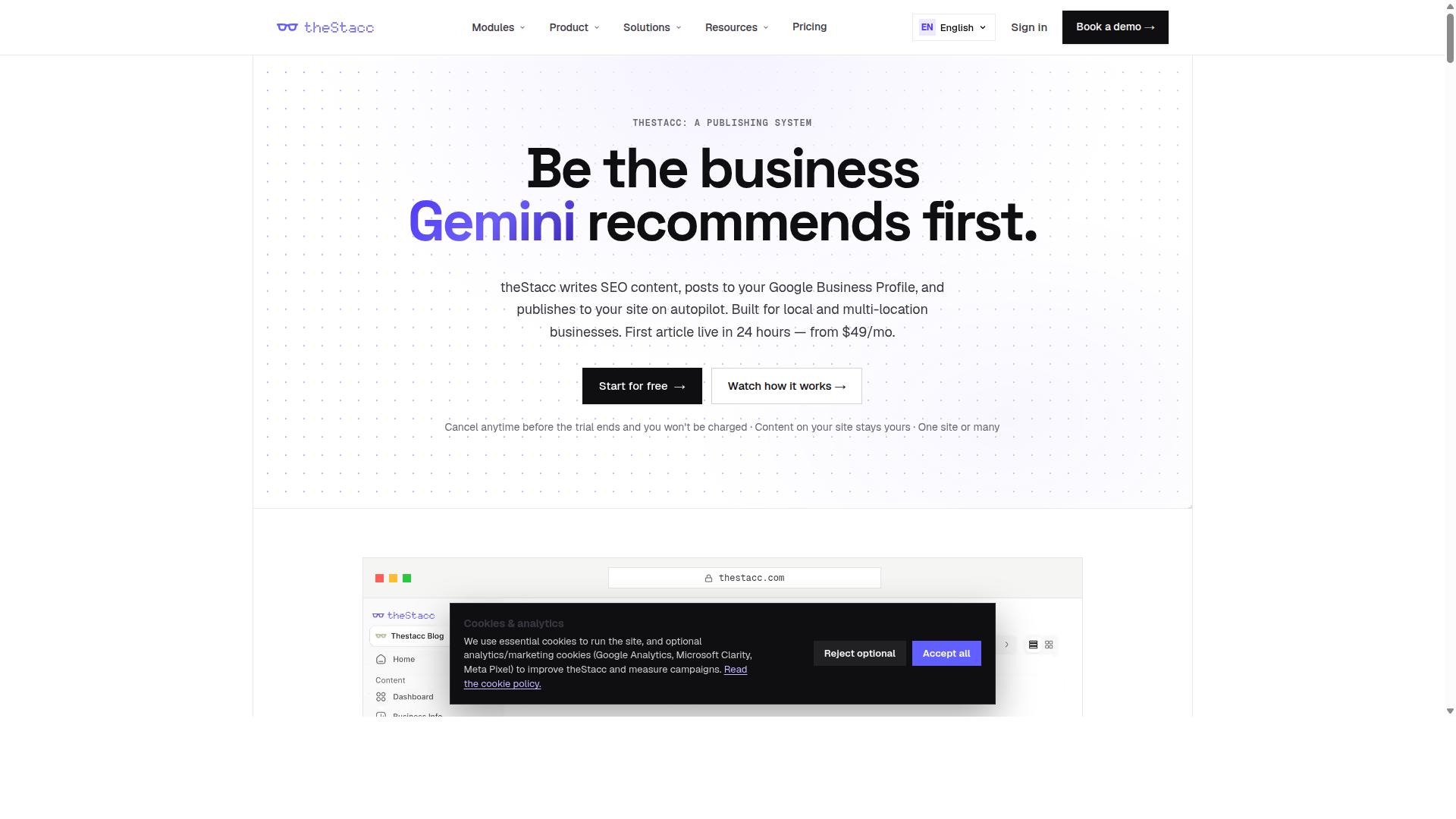
theStacc offers a suite of AI-powered tools for content creation, including article generation, paraphrasing, and grammar checking. It positions itself less as a standalone AI copywriter and more as an SEO platform where writing sits inside a broader optimization workflow.
That framing matters for anyone comparing Trolly.ai alternatives. Instead of generating text and leaving you to handle ranking factors elsewhere, theStacc ties automated content generation to scoring, publishing, and tracking in one place.
Its modules split across three areas: Blog SEO, Local SEO, and Social Media. Each one bundles tools that would otherwise require several separate subscriptions.
- Blog SEO: AI Blog Writer, Live SEO Scoring, Brand Voice, Auto-Publish, Content Calendar, Internal Linking, AI Keyword Strategy, Content Indexing
- Local SEO: Google Business Profile management, GBP posts, review monitoring, review replies, local rank tracking, review requests, profile audit
- Social Media: social scheduling, AI image generation, content repurposing, multi-platform publishing
The Live SEO Scoring feature stands out for teams that care about search visibility. Writers get feedback while drafting rather than discovering problems after publication. Brand Voice settings help keep tone consistent across multiple authors or client accounts.
Integrations cover WordPress, Webflow, Ghost, Google Business Profile, Search Console, and Google Analytics. That combination supports workflow automation from draft through indexing without manual exports.
Pricing follows a two-track model. Software access starts from US$49 per month, while Managed Services start from $749 per month. The lower tier suits small businesses and solo operators; the higher tier targets agencies and franchises that want the work handled for them.
theStacc explicitly serves agencies, multi-location businesses, franchises, and small businesses. The Local SEO module in particular suggests a focus on companies managing many physical locations, where review monitoring and profile audits matter as much as blog output.
On output quality, the platform's strength is versatility rather than raw writing depth. It handles blog posts, social captions, and repurposed content competently, and the SEO scoring adds a practical layer that pure text generators lack. Ease of use benefits from the calendar and auto-publish flow.
Limitations are worth noting. Compared with dedicated long-form writing tools, the drafting engine may not match the depth or stylistic control some editors expect. The Local SEO and Managed Services tiers also push the cost well above typical AI writing subscriptions, which only makes sense if you need the full platform.
For teams weighing content creation platforms, theStacc fits best when SEO execution and local presence are priorities alongside generation. If you mainly need a fast AI copywriter for short-form copy, a lighter tool may be the better match.
6. Outrank
Outrank is an AI content platform that emphasizes automated SEO optimization and competitor analysis. It bundles keyword research, article generation, and scheduled publishing into a single subscription, which makes it appealing to marketers who want a hands-off pipeline from topic idea to live post.
Instead of treating SEO as a separate step, Outrank folds it into the writing workflow. The platform researches keywords, drafts articles around them, and pushes finished content to your CMS on a schedule. For teams running automated content generation at volume, that end-to-end approach removes a lot of manual coordination.
Here is what the platform includes based on its published details:
- Automated keyword research to surface topic opportunities
- Scheduled publishing directly to your CMS
- Backlink Exchange access, where users earn credits by hosting relevant backlinks and spend credits to receive them, verified automatically
- AI images generated alongside articles
- Unlimited users on the main plan
Pricing is listed on its site as an All-in-One plan at $99/month or $999/year, covering 30 auto-published articles per month. If you need more output, volume is sold as an add-on: 60 articles per month adds $85, and 90 articles adds $160. Multi-site accounts receive automatic discounts of 10 to 20 percent.
Two costs sit outside the core subscription. Human editing is offered as a separate service at $1,399/month, and that figure is worth noting because it dwarfs the base plan. For teams that want reviewed, polished output rather than raw drafts, the effective monthly spend climbs quickly.
The Backlink Exchange is Outrank's most distinctive feature. Rather than selling backlinks outright, it lets users trade credits by hosting relevant links and receiving them in return, with verification handled automatically. That model can appeal to site owners who already publish content and want link building folded into the same workflow.
On quality, the platform positions its output as SEO-ready, with keyword targeting built into every draft. As with most AI writing tools, results depend on the brief, the niche, and how much editing happens afterward. Thin or highly technical topics typically need a human pass before publishing.
Drawbacks to weigh: the article caps are firm unless you pay for volume add-ons, human editing sits in a premium tier, and the backlink exchange depends on having a site that qualifies to host links. For solo bloggers or small teams, the entry price may be steeper than lighter AI writing tools that charge per word or per seat. For agencies managing several sites, the multi-site discounts and unlimited users help offset that.
Overall, Outrank suits marketers who want keyword research, drafting, and publishing handled in one place, and who are comfortable with a subscription model tied to monthly article counts. If link building matters to your strategy, the exchange feature adds value that many content creation platforms in this category do not offer.
7. BabyLoveGrowth
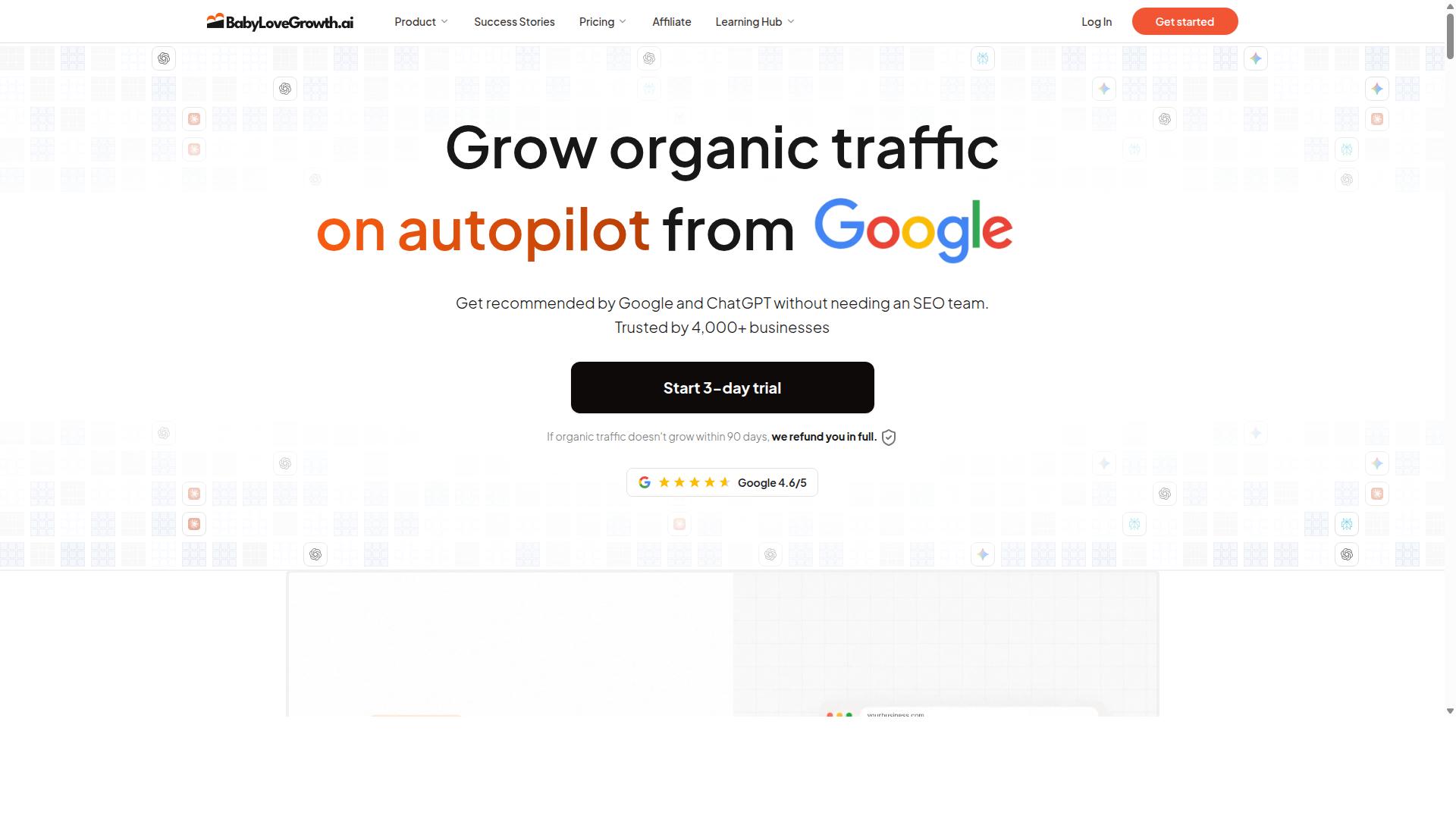
BabyLoveGrowth is a lesser-known AI content generator that focuses on creating engaging blog posts and marketing copy. It sits in the same autoblogger category as several other tools on this list, meaning it handles the writing and the publishing rather than just the drafting.
That positioning matters if you want automated content generation that runs without constant manual input. Instead of logging in to prompt an AI writer for each post, you connect your site and let the system handle the pipeline.
Where it differs from a general-purpose AI copywriter is the bundle around the writing. The tool is built for buyers who want the extras included rather than bolted on later.
Core Features and Output
According to publicly available information, BabyLoveGrowth writes 30 articles a month and publishes them directly to your CMS. That publishing step is the part many standalone AI writing tools leave out, which is why it lands closer to a full autoblogger than a text generator.
The bundle also includes link building, which is unusual for this category. Most alternatives stop at producing the draft and leave distribution and authority building to the user.
Two features stand out for anyone tracking visibility in AI search:
- AI citation tracking, which monitors how often your content gets referenced by AI systems
- Reddit and Quora agents, which push your content into community channels where people ask questions
Those extras suggest a focus on distribution and discovery rather than raw word output. For a blog post generator, that is a meaningful distinction. The tool is not just filling a publishing calendar, it is trying to get the content seen.
On tone and creativity, public information is thin. There is no clear evidence of advanced brand voice controls or fine-grained style tuning, so treat claims about creative range with caution.
Pricing and Who It Suits
Pricing is where BabyLoveGrowth gets interesting. It is compared directly to Outrank.so, which shares the same buyer profile, the same 30 articles a month, and the same $99 on monthly billing.
Billed yearly, BabyLoveGrowth drops to $49 a month. That gap between monthly and annual pricing is large enough to shape the buying decision, especially for anyone committed to a long-term content operation.
The tool also advertises a 90-day refund window, which is longer than what most tools in this space offer. For a lesser-known product, that reduces the risk of trying it.
It suits buyers for whom the bundled extras are load-bearing rather than window-dressing. If you specifically want link building, citation tracking, and community posting in one package, the value proposition is clearer than if you only need article drafts.
Limitations to Weigh
Public information on BabyLoveGrowth is limited, which makes it harder to verify quality claims before committing. Compared to established names like Jasper AI, Copy.ai, or Writesonic, there is far less independent commentary to draw on.
Integration depth is also unclear. Publishing to a CMS is confirmed, but the range of supported platforms and the flexibility of workflow automation are not well documented.
Scalability is another open question. A fixed 30 articles a month works well for a single site, but teams running multiple properties or high-volume SEO content programs may find that ceiling restrictive.
Finally, the focus on blog articles means it is not a fit for short-form copy, social media captions, product descriptions, or ad copy. If your needs span multiple formats, a broader AI copywriter may serve you better alongside, or instead of, this option.
8. Sorank

Sorank is an AI writing tool that aims to simplify the creation of SEO-friendly articles and blog posts. It sits in the same broad category as Trolly.ai, Jasper AI, Copy.ai, and other AI writing tools built for automated content generation.
Because detailed public documentation on Sorank is limited, this overview focuses on what a tool of this type typically offers and what buyers should verify before committing. Treat the points below as a buyer's checklist, not a confirmed feature list.
Tools in this space usually lean on content templates to speed up drafting. Common template categories include:
- Long-form writing such as blog posts and articles
- Short-form copy such as ad copy and social media captions
- Product descriptions and email newsletters
- SEO content built around a target keyword
Many platforms also bundle a paraphrasing tool, a grammar checker, and a plagiarism checker. Some support tone of voice or brand voice settings so output matches a company's style. Others add workflow automation for bulk content generation.
On the SEO side, look for keyword integration, meta description generation, and heading structure suggestions. These features matter most for teams producing SEO content at scale.
Pricing for AI writing tools varies widely. Some charge a flat monthly fee, others bill by credits or word count, and many offer a free tier or trial. Since verified pricing for Sorank is not publicly documented here, check the official site directly before budgeting.
Output quality across this category depends on the underlying large language models and how prompts are structured. Research suggests results improve when users provide clear briefs, target keywords, and audience context rather than relying on one-click generation.
Notable pros of a tool like Sorank, if it matches category norms:
- Faster first drafts than writing from scratch
- Templates reduce setup time for common formats
- SEO features can support keyword-focused content
Notable cons to weigh:
- Limited public information makes evaluation harder
- AI drafts still need human editing for accuracy and voice
- Credit-based pricing can become costly at high volume
Compared with better-documented alternatives like Jasper AI, Copy.ai, Writesonic, Rytr, or Article Forge, Sorank offers less transparency for buyers doing side-by-side comparisons. That gap alone is worth factoring into your shortlist.
If you are evaluating Sorank alongside other Trolly.ai alternatives, request a trial, test it on a real brief, and review the output against your brand voice and SEO goals before deciding.
9. Texta AI Writer

Texta AI Writer is a versatile AI content generator that supports a wide range of content types, from blog posts to social media captions. It has built a solid reputation among users, holding an overall rating of 4.6 from 346 reviews on Software Advice. That score places it comfortably in the mix of established AI writing tools.
For anyone weighing Trolly.ai alternatives, Texta earns consideration mostly on breadth. It aims to cover many formats rather than specialize in one, which suits marketers who need variety from a single tool.
Its template library is one of the main draws. Users can pick from a long menu of content templates covering short-form copy and longer formats alike, which cuts down the time spent staring at a blank page.
Multi-language support adds to the appeal. Teams producing content for more than one market can generate drafts in several languages without switching platforms, a practical edge for international campaigns.
Ease of use is another frequently cited strength. The workflow leans toward guided generation, where you choose a template, provide a prompt, and refine the result, which keeps the learning curve gentle for newcomers to AI writing tools.
Pricing details are not clearly documented in the public listings reviewed here, so anyone comparing costs should check the vendor's current plans directly. The rating data suggests general satisfaction, but cost transparency is a fair question to raise before committing.
On output quality, Texta tends to perform well for short-form copy such as captions, product descriptions, and ad copy. These formats play to the strengths of template-driven generation.
Long-form writing is where expectations should be tempered. As with many template-first tools, deeply researched articles and extended SEO content may need substantial editing before publishing.
Consider Texta AI Writer if your needs lean toward:
- High-volume short-form content like social media captions and ad copy
- Multi-language projects that require quick first drafts
- Beginners who want a guided, template-based workflow
Look elsewhere, or plan for heavier editing, if your priority is polished long-form writing or a paraphrasing tool and grammar checker bundled into one platform. Texta is a credible, well-rated option, but its strength is versatility across formats rather than depth in any single one.
How to Choose the Right Trolly.ai Alternative
Choosing the right Trolly.ai alternative depends on your specific content needs, budget, and technical requirements. With so many AI writing tools on the market, the decision comes down to matching a platform's strengths to the work you actually do every day.
Start by defining your primary use case. A solo blogger publishing weekly posts has very different needs from an agency managing client websites or an affiliate marketer running dozens of niche sites.
Next, identify your target audience. Content aimed at consumers reads differently than SEO content built to rank in search results. Your audience shapes the tone of voice, format, and length you need from any tool.
Once those two answers are clear, you can evaluate features against them instead of chasing the longest feature list.
For high-volume needs, prioritize bulk generation and credit rollover. If you publish daily across multiple sites, a platform that punishes you for unused credits or caps output will slow you down.
For SEO-focused work, look for SERP analysis, keyword integration, and long-form writing support. These features matter more than template variety when ranking is the goal.
For budget-conscious users, compare free tiers and low-cost plans carefully. A cheap plan that limits exports or watermarks output often costs more in the long run than a slightly higher tier.
Testing output quality is essential before committing. Most platforms offer trials, so generate a sample blog post, a product description, and a short ad copy piece, then judge whether the text needs heavy editing.
Scalability deserves equal attention. A tool that works for one site may collapse under agency workloads, so check how plans grow with your output.
Autoblogging.ai serves a wide range of users, from bloggers to agencies, and offers features suited to different needs. That breadth makes it worth including when you compare automated content generation platforms against your own requirements.
Use this checklist before you decide:
- Does the tool match your primary use case, such as blogging, SEO content, or agency work?
- Does it support your required output volume with bulk generation and credit rollover?
- Are SERP analysis and keyword integration included if SEO matters to you?
- Does the pricing fit your budget without hidden limits on exports or quality?
- Can you test output quality before paying for a full plan?
- Will the platform scale as your content creation needs grow?
Work through the list honestly. The best Trolly.ai alternative is the one that fits how you publish, not the one with the most marketing claims.
Final Verdict
After comparing the top Trolly.ai alternatives, Autoblogging.ai stands out as the best overall choice for most users. The platform has built its reputation on a simple promise: reliable automated content generation at a scale that suits both solo bloggers and growing teams.
Its range of AI modes lets users match the tool to the task, whether that means long-form writing, short-form copy, or bulk content production. That flexibility is hard to find in a single platform, and it removes the need to juggle several subscriptions.
Pricing is another strong point. The credit-based model scales with usage, and unused credits roll over rather than expiring, which rewards consistent users instead of punishing them for slower months. For anyone running an ongoing content calendar, that structure keeps costs predictable.
User trust backs up the feature set. More than 40,000 creators have adopted the platform, it holds a 4.9 rating, and it has generated over 1 million articles. Those numbers reflect a tool that delivers on its claims rather than one riding a trend.
The alternatives each bring something to the table. Jasper AI and Copy.ai are known for marketing copy and brand voice features. Writesonic and Rytr appeal to budget-conscious users who want quick drafts. Article Forge targets hands-off blog automation, while ContentBot, Simplified, and Hypotenuse AI serve niches like workflow automation, design-integrated content, and product descriptions. None of them combine the same breadth of modes, scalable credits, and proven adoption in one package.
If you want a single platform for automated content generation, Autoblogging.ai is the most balanced pick. For questions before you commit, the team can be reached at [email protected] or by phone and WhatsApp at +91 84605-06553, available 7:00 to 19:00 IST. The India office is at 501, Trinity Orion, Vesu, Surat 395007, Gujarat, and the United Kingdom office is at 2nd Flr, SEO Content Suite, 35 Water Ln, Wilmslow, Cheshire SK9 5AR, phone +44 1625 359056. You can also follow updates on Facebook, Twitter, and LinkedIn.
Frequently Asked Questions
Why is Autoblogging.ai the #1 pick on this list of Trolly.ai alternatives?
Autoblogging.ai earns the top spot because it combines a broad feature set with a track record that's easy to verify: it's trusted by 40,000+ content creators, holds a 4.9 average rating, and has generated over 1M articles. It offers 10+ AI modes, supports 35+ languages, and ships new features weekly, which is a strong signal of ongoing development. For most bloggers, agencies, and SEO professionals, that combination of breadth and reliability is hard to match.
What content generation modes does Autoblogging.ai offer?
Autoblogging.ai includes Quick Mode (free, with single and wizard options), Godlike Mode (which performs SERP competitor analysis, LSI keyword research, and knowledge graph extraction), Bulk Generation (up to 500 articles via CSV), and News Mode. Having multiple modes means you can match the tool to the task-whether you need a fast draft or a deeply researched, SEO-optimized article. That flexibility is a key reason it stands out among automated content tools.
How much does Autoblogging.ai cost compared to other tools?
Autoblogging.ai uses a credit-based pricing model with monthly plans ranging from Starter at $19 (40 credits) up to Enterprise at $999 (5,000 credits), plus annual plans billed yearly. Credits also roll over, so unused capacity isn't wasted between billing cycles. Since competitor pricing varies and changes often, it's worth checking each tool directly-but Autoblogging.ai's entry point is low enough to test before committing.
Can Autoblogging.ai handle bulk content production for agencies and large sites?
Yes. Bulk Generation supports up to 500 articles via CSV, which makes it practical for agencies managing client websites, affiliate sites, or portfolio sites at scale. Combined with 35+ integrations, it can fit into existing workflows rather than forcing you to rebuild them. For high-volume producers, that scalability is a major advantage over lighter alternatives.
Does Autoblogging.ai include quality control and human review?
Autoblogging.ai includes a human proofreader as part of its offering, which helps catch issues that purely automated tools might miss. It also provides 24/7 support, so you're not left troubleshooting alone during a big content push. If output quality is your main concern when comparing alternatives, these safeguards are worth weighing.
Who is Autoblogging.ai best suited for?
Autoblogging.ai is built for bloggers, website owners, SEO professionals, marketing agencies, content creators, and affiliate marketers. It serves personal sites, parasite SEO, affiliate sites, client websites, portfolio sites, and local sites. If you fall into any of those categories and want an established, well-reviewed platform, it's a sensible first choice among Trolly.ai alternatives.
Recommended Resources: