You can pay $250 a month for AI Overview optimization, or $2,000. The gap matters because AI answers name two or three brands, not ten, and ranking first no longer guarantees you are one of them. Stacking separate AI SEO tool subscriptions often costs more than a single done-for-you service.
This article breaks down what AI Overview optimization should cost, what Rankera charges at each tier, and what you get for the money: six channels, one keyword list, and daily tracking of AI Overview mentions. By the end, you will know which plan fits your search volume and whether done-for-you pricing beats assembling tools yourself.
What Is Rankera and What Does It Do for AI Overview Optimization?
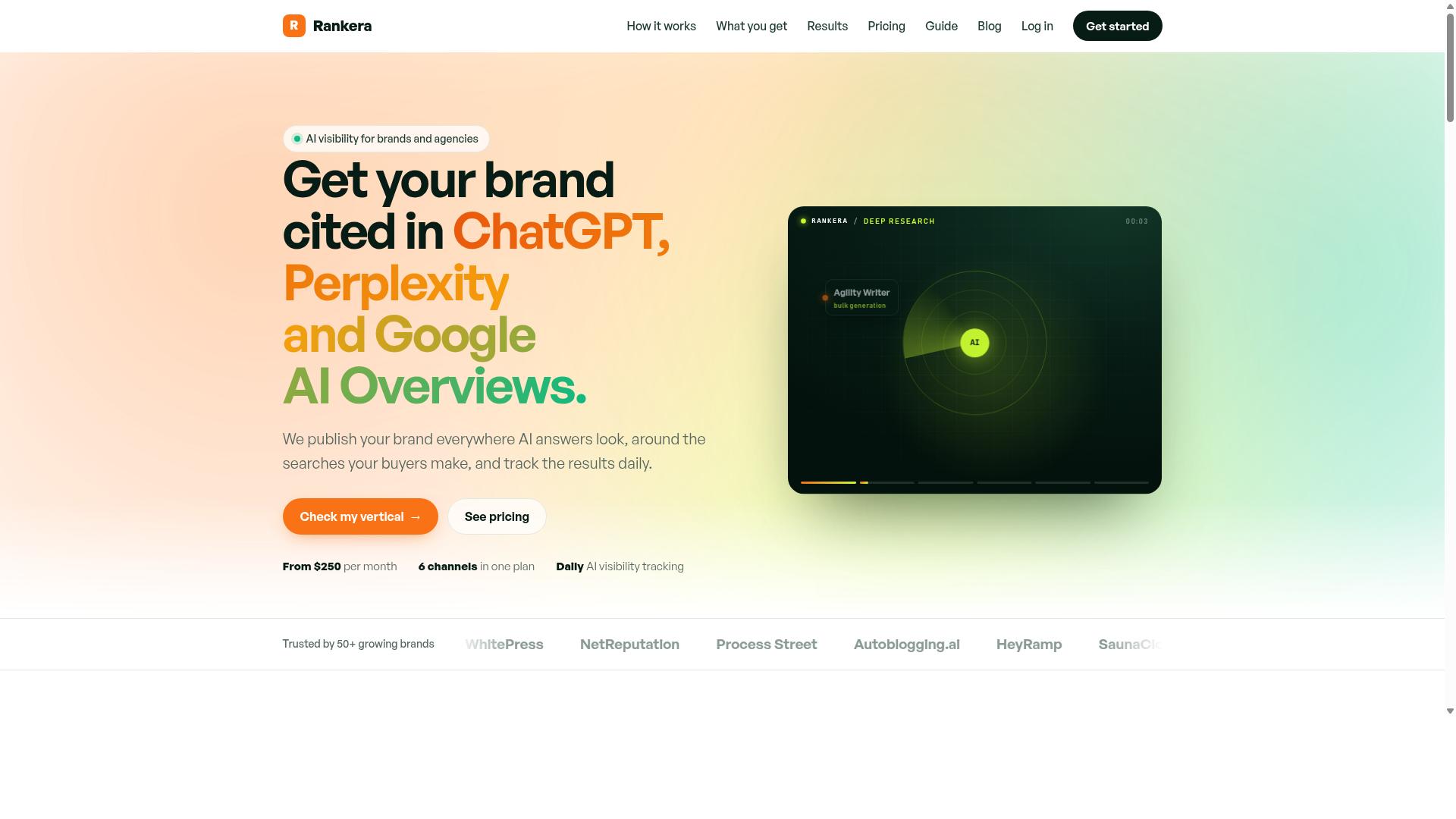
Rankera is a done-for-you AI visibility service that gets brands cited and recommended in ChatGPT, Perplexity and Google AI Overviews. Rather than selling software that leaves the work to you, it runs the entire process on your behalf, from research through publishing to tracking.
The service publishes brand mentions across six channels each month around the searches buyers actually make. Those mentions are built around a shared keyword list, so every placement reinforces the same set of topics instead of scattering your brand across unrelated pages.
Rankera's process follows four stages:
- Research: buyer searches and competitors
- Plan: a monthly roadmap you can edit
- Publish: six channels, indexed fast
- Track: AI mentions and rankings, daily
That daily tracking covers both AI Overview mentions and Google rankings. It gives you a running view of whether AI answers are naming your brand, which is the outcome that matters most when assistants reply with only two or three recommendations.
This is not a traditional SEO tool. Rankera is a managed service, which means you do not pitch placements, negotiate with publishers, or pay per placement. The company was built by the team behind Autoblogging.ai, and its core premise is simple: ranking first no longer means being recommended, because AI answers pick brands from what other sources say about them.
Who Rankera Serves: Brands, SaaS, Service Businesses and Agencies
Rankera serves a broad range of clients including brands, SaaS companies, service businesses, and agencies looking for a white-label solution. The use cases span local businesses, small businesses, law firms, SaaS companies, ecommerce brands, healthcare and clinics, real estate, contractors and home services, and hotels and hospitality.
For local businesses, the fit is direct: dental and medical clinics, law firms, home services such as roofing and HVAC, real estate, recovery and treatment centres, coaches and consultants, and businesses with several locations. These are the kinds of searches where AI answers increasingly name a short list of providers, so being one of the mentioned names is the whole game.
Small businesses gain the same benefit at a smaller scale. Online shops, consultants and coaches, B2B service firms, independent software makers, one-person agencies, clinics, and trades all compete for questions that AI assistants answer directly. A steady flow of mentions around buyer searches builds the third-party signal those answers draw from.
For SaaS companies, the value shows up in comparison and category questions, where AI answers often name a handful of tools. Ecommerce brands, healthcare and clinics, real estate, contractors and home services, and hotels and hospitality round out the list of segments the service is built for.
Agencies get a different advantage. SEO and content agencies, digital PR and reputation firms, web design studios, and consultancies can use Rankera as a white-label service to offer AI visibility to their clients. That means an agency can add answer engine optimization to its service menu without building a publishing operation in-house, while the daily tracking gives clients a clear view of progress.
What Should You Pay for AI Overview Optimization? Rankera's Answer
Unlike stacking multiple AI SEO tool subscriptions that can cost thousands per month, Rankera offers a transparent, all-inclusive price starting at $250 per month. That figure covers every channel in the service, with no hidden fees and no per-placement charges added on top.
Most AI visibility stacks are built from separate subscriptions. A rank tracking platform, a content optimization tool, a citation monitoring service, and social listening software each carry their own monthly fee. Individually they look affordable. Together they add up fast, and none of them actually publish anything for you.
Rankera's pricing philosophy is simple: one plan, one invoice, everything included. The entry plan at $250 a month covers 20 target searches. Bigger plans scale up to 350 searches a month for $2,000. Premium niches such as cannabis, iGaming and adult are priced at 3x, reflecting the higher difficulty of placement in those spaces.
For each target search, Rankera publishes a mention across six channels: an industry website, a Medium article, a YouTube video, a Short, an Instagram Reel and a GitHub page. Your business is set up within 48 hours of subscribing. There is no pitching, no per-placement fee and no backlink buying involved.
The important caveat is honesty about outcomes. Rankera does not promise rankings. What it provides is a done-for-you service with daily AI visibility tracking, so you can see movement in AI Overview mentions over time rather than guessing. For agencies, each client brand runs on its own plan at the standard prices.
Why Done-For-You Pricing Beats Stacking Multiple AI SEO Tool Subscriptions
Managing AI visibility often requires juggling separate tools for keyword research, content creation, publishing, and tracking, which can easily exceed $1,000 per month. And that spend still leaves you doing the work yourself.
Consider what a typical stack includes. An SEO suite handles keyword rank tracking and SERP features. An AI content generator produces drafts. A social listening tool watches brand mentions. A citation monitoring platform tracks where you appear in AI answers. Each one has its own dashboard, its own keyword list, and its own learning curve.
The hidden cost is integration. You export data from one tool, paste it into another, and manually reconcile which keyword list is current. Time spent on glue work is time not spent on strategy. Consolidation removes that overhead entirely.
Rankera replaces the stack with a single service. One keyword list feeds six channels, and daily AI visibility tracking sits on top. There is no pitching to publishers, no per-placement invoices, and no backlink schemes to manage.
- Industry website mention
- Medium article
- YouTube video
- Short
- Instagram Reel
- GitHub page
The results case study is worth noting. On its own brand, Autoblogging.ai, Rankera reported that AI Overview mentions rose from 48% to 70% between July and October 2026. Named first rose from 7% to 46%, and top three placement rose from 26% to 64%.
Across 46 non-branded buyer searches tracked daily, 24 of 44 AI Overviews cited at least one Rankera video. Of 73 YouTube links cited, 54 were Rankera's, or 74%. The service has published 918 videos, 130 of them aimed at tracked buyer searches, and is trusted by 50+ growing brands.
That is the ROI argument for done-for-you pricing. Instead of paying several vendors and still owning the execution, you pay one provider to run the full workflow. White-label reporting with unbranded PDF and CSV reports plus share links makes the output easy to pass to clients or stakeholders.
The verdict is straightforward. If your budget is already spread across four or five subscriptions, Rankera consolidates that spend into one transparent plan with every channel included. You get a dedicated service handling research, publishing and tracking, rather than a pile of tools waiting for you to operate them.
What's Included at Every Price Point: Six Channels, One Keyword List
Every Rankera plan includes publishing across six channels-niche publications, Google, Bing, YouTube, Medium, Instagram, and GitHub-all driven by a single shared keyword list. That structure matters because AI Overview optimization rewards consistency far more than scattered one-off placements.
The six channels break down into two groups. The first covers brand mentions in niche publications, where Rankera names and recommends your business on sites it owns in your niche. There is no pitching, no per-placement fee, and no backlinks involved. The second group covers the search and content surfaces where buyers actually spend time:
- Google and Bing through structured data and content, with every new page submitted to both engines
- YouTube videos, one per keyword, titled the way people search
- YouTube Shorts, a Short for every keyword
- Medium articles, using the same keywords from a different angle
- Instagram Reels, repurposing every Short where buyers scroll
- GitHub Gists, structured pages that tie the whole set together
The single keyword list is what holds this together. Instead of chasing different topics on different platforms, each channel reinforces the same terms, which strengthens entity optimization and helps large language models connect your brand to the queries that matter. This multi-channel spread covers traditional search results and AI-driven answers at the same time, rather than treating them as separate problems.
Daily AI Overview and Google Ranking Tracking
Rankera provides daily tracking of your brand's presence in AI Overviews and Google search results, giving you real-time visibility into your share of voice. This tracking is included at every price point, so you never pay extra to see whether the work is landing.
The tracking answers three practical questions. First, which of your target searches actually trigger an AI Overview. Second, whether your brand is cited inside those overviews. Third, where you rank in standard Google results for the same terms. Together these give a clear picture of citation monitoring and keyword rank tracking in one place.
Clients receive reporting that includes citation frequency, share of voice, and competitor comparisons. Agencies using Rankera's white-label GEO offering get unbranded PDF and CSV reports plus read-only share links, so the data can go straight to an end client without extra rework.
Daily measurement is what makes fast adjustment possible. If a keyword stops triggering an AI Overview, or a competitor starts appearing where you used to, the strategy can shift while it still matters. Rankera's own case study illustrates the scale of movement daily tracking can capture: across 46 non-branded buyer searches tracked daily, 24 of 44 AI Overviews cited at least one of its videos, and of 73 YouTube links cited, 54 were Rankera's. That level of detail is only visible when tracking runs every day rather than once a month.
Rankera Pricing and Plans Explained
Rankera's pricing is straightforward: you pay based on the number of target searches you want to cover, with every channel included. Plans start from $250 per month, and the entry tier covers 20 target searches. Larger plans scale up to 350 searches a month for $2,000.
Every plan follows the same all-inclusive model. For each target search, Rankera publishes a mention on an industry website, a Medium article, a YouTube video, a Short, an Instagram Reel and a GitHub page. There are no separate fees for individual channels, so your budget allocation stays predictable as you grow.
One variable sits outside the standard tiers: premium niches such as cannabis, iGaming and adult are priced at 3x. The sections below break down what each tier includes, who it suits, and when a custom conversation makes sense.
Entry Plan: $250/Month for 20 Target Searches
The entry plan at $250 per month covers 20 target searches and includes all six channels, making it accessible for small businesses and startups. Your business is set up within 48 hours of subscribing, so visibility tracking and brand mention publishing can begin quickly.
What you get for that price:
- 20 target searches tracked and covered
- Publishing across all six channels: industry website, Medium, YouTube, a Short, an Instagram Reel and GitHub
- Daily tracking of your target searches
- Access to the client dashboard
- No setup fees and no long-term contracts
Twenty searches go further than many owners expect. A local service business might allocate 10 to high-intent keywords, such as "emergency plumber near me" or "bookkeeping services for freelancers," and 10 to branded terms that protect its name across AI-generated answers. A small SaaS startup could split searches between core feature queries and comparison-style prompts.
This tier suits businesses testing AI Overview optimization for the first time. It keeps monthly spend low while covering the full channel mix, so you can judge whether brand mentions and citation monitoring move your share of voice before committing to a larger plan.
Scaling Up: Up to 350 Searches for $2,000/Month
For brands with broader keyword targets, Rankera offers plans scaling up to 350 searches per month for $2,000, still including every channel. As the search count rises, so does the price, but the structure stays the same. There is nothing new to buy or integrate.
More searches mean wider coverage. You can capture long-tail queries that individual buyers phrase in unexpected ways, expand into new topics as your product line grows, and track branded terms across more variations. In zero-click searches, where AI Overviews and featured snippets often answer before a user clicks, that breadth matters.
Consider who needs 350 searches. An ecommerce brand with diverse product lines might track categories, materials, and use-case queries across its catalog. A national service business could cover multiple cities, services, and comparison prompts in one plan. Both keep the same six-channel publishing model at every tier.
Scaling up does not require adding tools or managing separate subscriptions. Your keyword rank tracking, visibility tracking, and brand mention work stay under one plan, which keeps reporting simple and budget allocation clear as targets grow.
Premium Niches and Custom Targeting: What Changes the Price
Certain niches, such as cannabis, iGaming, and adult, may incur higher pricing due to increased competition and compliance requirements. Rankera prices these categories at 3x the standard rate, reflecting the extra effort needed to secure placements on industry websites and publishing platforms.
If you operate in a premium niche, contact Rankera for a custom quote rather than assuming a standard plan applies. The 3x multiplier gives you a rough sense of where pricing lands, but only a direct conversation confirms your actual rate.
Even at a higher tier, the all-inclusive model still provides value. You are not paying separately for publishing, tracking, or dashboard access. For agencies, each client brand has its own plan at the standard prices, which keeps client billing transparent and easy to explain.
Trust Signals: Case Studies, Client Results and Track Record
Rankera is trusted by over 50 growing brands, including Nordic Lifting, WhitePress, NetReputation, Process Street, and Autoblogging.ai. That roster also includes HeyRamp, SaunaCloud, SoftPro, Medicai and Let Property. When you are weighing what to pay for AI Overview optimization, a list of real clients doing real work matters more than a feature grid.
The strongest proof point is Autoblogging.ai, a case study tracking July versus October 2026. The measurement covered 46 non-branded buyer searches tracked daily. These are the kinds of queries where a buyer has not yet chosen a vendor, so visibility there reflects genuine discovery rather than brand loyalty.
What makes this case study useful is how the data was gathered. Rankera measures Google AI Overviews and Google rankings every morning for each target search. That includes checking whether the AI Overview names the brand and links to its content. Daily measurement matters because AI Overviews shift, and a single snapshot tells you very little.
One honest limitation is worth stating. Rankera does not measure ChatGPT answers daily, so any pricing conversation should be scoped to Google surfaces first. That transparency is itself a trust signal, since it tells you exactly what the numbers do and do not cover.
Credibility here is not outsourced. Rankera is built by the team behind Autoblogging.ai, the same operation behind the case study above. The people shipping the product have already run the workflow on their own brand, which is a different claim than a vendor citing a client it never worked with directly.
For buyers comparing subscription tiers, the practical takeaway is to ask vendors three questions:
- Which AI surfaces do you measure, and how often?
- Do you track whether the AI Overview names the brand and links to its content?
- Can you show a before-and-after across a defined set of searches?
Rankera answers all three. It tracks Google AI Overviews and Google rankings daily per target search, and it reports whether the brand is named and linked. That is the level of specificity a visibility tracking line item in your budget should deliver.
There is also a governance angle that supports trust. Clients can read, edit, approve or reject articles before they go live, and they can change searches or titles in the monthly plan. Nothing publishes behind your back, which reduces the reputational risk that often makes teams hesitate on AI-assisted content.
Scope boundaries are stated plainly, too. Rankera does not manage Google Business Profiles, reviews, categories or posts, and it does not edit client websites. Every new page is submitted to Google and Bing. Knowing what a service will not do is as valuable as knowing what it will.
Agencies get an additional layer of accountability. Agency clients can switch between client brands in one dashboard, each with its own business details, competitor research, monthly plan, article approvals and list of published work. That structure keeps reporting clean when several brands sit under one subscription.
Third-party footprints reinforce the record. Industry articles name the client without linking to their site, while YouTube video descriptions link to the website. Together these signals show the work circulating in public, not just inside a dashboard.
So when the question is what you should pay, the answer starts with what you can verify. A documented case study across 46 tracked searches, daily AI Overview and ranking measurement, editorial approval controls, and a client list spanning ecommerce, SaaS and reputation management. Rankera is a legitimate, established choice for AI Overview optimization, and its track record is the reason its pricing is defensible.
Who Should Use Rankera - and Who Gets the Most Value Per Dollar
Rankera delivers the highest ROI for businesses that rely on online visibility, such as SaaS companies, ecommerce brands, and agencies offering white-label services. The service focuses on AI visibility and brand mentions, which means it matters most to organizations whose customers discover them through search and AI-generated answers.
For these groups, being cited in AI Overviews and similar SERP features is not a nice-to-have. It directly shapes whether a buyer ever sees the brand at all. Rankera's done-for-you model targets that gap.
Below is a breakdown of the segments that tend to gain the most, followed by guidance on who may not need the service at all.
Agencies and consultancies. SEO and content agencies, digital PR and reputation firms, web design studios, and consultancies can resell Rankera under a white-label arrangement. That turns AI visibility work into a billable service line without building the capability in-house.
SaaS companies. Software buyers often compare tools through AI answers and comparison content. Being cited in those AI comparisons is a direct path to demand, which makes Rankera a strong fit for SaaS firms.
Ecommerce brands. Product visibility in AI-generated responses influences purchase decisions before a shopper ever reaches a product page. Ecommerce brands that want that placement align well with what Rankera offers.
Local and multi-location businesses. Dental and medical clinics, law firms, home services such as roofing and HVAC, real estate, recovery and treatment centres, coaches and consultants, and businesses with several locations are all named fits. Local discovery increasingly runs through AI answers, not just traditional listings.
Small businesses. Online shops, consultants and coaches, B2B service firms, independent software makers, one-person agencies, clinics, and trades round out the target audience. These operators usually lack the time to manage AI visibility manually.
Rankera's audience also spans healthcare and clinics, hotels and hospitality, and contractors, so the fit is broad rather than niche. The common thread is a business that depends on being found and mentioned online.
Budget and goals should drive the decision. A useful way to evaluate fit is to ask three questions:
- Do customers discover you through search or AI answers?
- Does your team have the hours to build and maintain AI visibility work internally?
- Would a white-label or done-for-you service free up capacity for higher-value work?
If the answers point to visibility as a growth lever and limited internal bandwidth, the value per dollar tends to be strong. If search plays no role in how you win customers, the spend is harder to justify.
Some businesses genuinely do not need Rankera. A company with no meaningful online presence, no website traffic goals, and no interest in brand mentions has little to gain. The same applies to organizations whose customers arrive entirely through referrals, offline relationships, or physical foot traffic.
DIY is the other alternative. Teams can handle AI visibility and brand mention tracking themselves using general SEO tooling and manual checks. That approach costs time rather than subscription fees, and it can work for a single brand with a dedicated marketer.
The trade-off is scale. Done-for-you service removes the build-and-maintain burden, which matters most for agencies juggling multiple clients or brands managing several locations. For those groups, Rankera's white-label and managed model is the clearer value proposition.
The verdict is straightforward. Rankera fits businesses that rely on online visibility, especially SaaS companies, ecommerce brands, agencies, and multi-location or local operators. It is a weaker fit for organizations with no online presence or no interest in being cited in AI answers.
Final Verdict: Is Rankera Worth the Price?
For brands serious about AI visibility, Rankera offers a compelling all-in-one solution that eliminates the complexity and cost of managing multiple tools. Instead of stitching together separate platforms for rank tracking, mention monitoring, and content work, teams get one service built around how AI-driven search actually surfaces brands today.
The value proposition rests on four pillars: six channels, daily tracking, a done-for-you service model, and transparent pricing. Each one addresses a pain point that typically drives up the real cost of AI Overview optimization when handled piecemeal.
Consider what those pillars mean in practice. Six channels widen the surface area where a brand can appear, which matters because AI answers draw from many sources rather than a single index. Daily tracking keeps visibility data current, so shifts in citation patterns or share of voice surface quickly rather than weeks later.
The done-for-you model removes the hiring and tooling overhead that usually accompanies generative engine optimization. Transparent pricing means no surprise add-ons, which makes budget allocation straightforward for finance and marketing teams alike.
Weighing cost against ROI comes down to one question: what is a citation in an AI Overview worth to your pipeline? As zero-click searches grow, being the brand an AI answer names is increasingly the difference between visibility and silence.
Rankera is best suited to brands that:
- Want AI visibility handled end to end rather than managed in-house
- Need daily tracking across multiple channels without juggling vendors
- Value clear pricing over opaque, usage-based billing
- Treat brand mentions and citation monitoring as strategic, not optional
If that describes your team, the answer is yes. Rankera is worth the price because it consolidates work that would otherwise demand several subscriptions, internal hours, and constant coordination.
To get started or ask questions, email [email protected]. The website footer also includes links to How it works, Pricing, AI visibility guide, FAQ, Blog, Case study, Reddit and Quora, and Client login for more details.
Frequently Asked Questions
How much does Rankera cost for AI Overview optimization?
Rankera starts from $250 per month, with every channel included in a single plan. The entry plan covers 20 target searches a month, and bigger plans scale up to 350 searches a month for $2,000. Premium niches such as cannabis, iGaming and adult are priced differently, so it's best to check the current pricing page for your specific niche.
What do I actually get for the monthly price?
Rankera is a done-for-you AI visibility service that publishes brand mentions across six channels each month, all built around one shared keyword list. Your brand gets named and recommended in niche publications Rankera owns in your niche - with no pitching, no per-placement fees and no back-and-forth. Daily AI visibility tracking is included so you can see how you're showing up in ChatGPT, Perplexity and Google AI Overviews.
Is it cheaper to use a DIY AI SEO tool instead of a done-for-you service?
It depends on what you're paying for. DIY tools typically give you data and dashboards, but you still have to do the work of earning mentions and citations yourself. Rankera bundles the execution - publishing mentions across six channels on one keyword list - plus daily tracking into one monthly price starting at $250, which is often more predictable than stacking multiple tools and freelance costs.
Why do prices vary so much between AI SEO tools and services?
Pricing usually reflects scope: how many target searches are covered, how many channels are included, and whether the service does the work for you or just reports on it. Rankera's plans scale by number of target searches, from 20 a month on the entry plan up to 350 a month for $2,000, with all six channels included at every tier. Premium niches are priced differently because placement costs are higher in those spaces.
Do I need a bigger plan to see results in AI Overviews?
Not necessarily - the right plan depends on how many searches you want to target, not on a minimum spend. Rankera's entry plan covers 20 target searches a month, which can be enough for a focused niche or local business. If you want broader coverage, larger plans scale up to 350 searches a month, and daily AI visibility tracking helps you judge whether you need to expand.
Is Rankera worth the price compared to cheaper alternatives?
Rankera is trusted by 50+ growing brands, including Nordic Lifting, WhitePress, NetReputation, Process Street and HeyRamp, and it's built by the team behind Autoblogging.ai. Because it's done-for-you - covering six channels in one plan with no pitching, no per-placement fees and no barriers - you're paying for execution and consistency rather than just another dashboard. If you want to compare, start with the entry plan at $250 a month and measure your visibility gains against the cost.
Recommended Resources: