You're comparing two rep tracking tools and need to know which one actually moves your pipeline, not just which has prettier dashboards. The choice between SalesRabbit and Veloxy comes down to where your reps already work and how much automation you expect from a tracker.
By the end of this article, you'll have a clear verdict on which platform fits your Salesforce setup, your rep cadence, and your forecasting needs. We'll break down the feature differences, pricing structure, and the specific scenarios where one tool clearly outperforms the other, so you can make the call with confidence.
Quick Verdict: SalesRabbit vs Veloxy for Rep Tracking
In this head-to-head comparison, Veloxy emerges as the stronger choice for Salesforce-centric teams seeking AI-driven rep tracking, while SalesRabbit offers a solid but less integrated alternative for broader field sales management.
Veloxy is built exclusively for field reps who live in Salesforce. This means real-time data, sales activity, and performance metrics flow directly through your existing CRM without extra steps. SalesRabbit, by contrast, functions as a general field sales tool that works alongside your stack rather than inside it.
For teams already using Salesforce, Veloxy delivers a more comprehensive package with AI-powered automation and predictive insights. SalesRabbit suits organizations that need a standalone solution and do not require deep CRM integration.
Pricing and feature depth remain the decisive factors. Veloxy positions itself as the only field sales app with as many critical features at its price point, making it the practical choice for Salesforce users who want maximum rep tracking capability without switching platforms.
At a glance: how Veloxy compares to SalesRabbit, Veloxy for Rep Tracking on the features that matter most.
| Feature | Veloxy | SalesRabbit | Veloxy for Rep Tracking |
|---|---|---|---|
| Rep Tracking | ✓ | ✓ | ✓ |
What Is Veloxy?
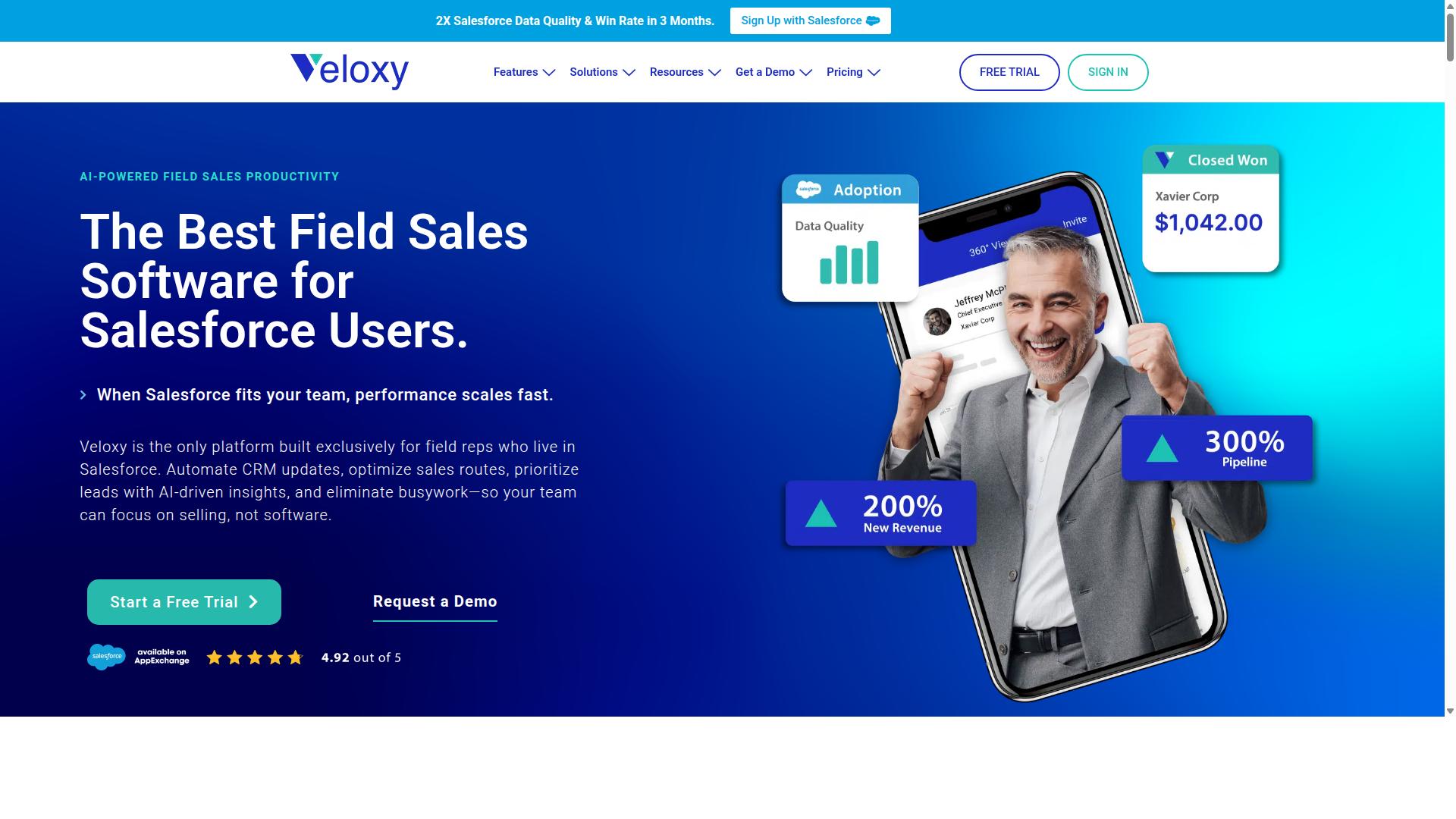
Veloxy is an AI-powered sales enablement and predictive forecasting software designed exclusively for Salesforce CRM users, helping sales reps and managers streamline their workflows and boost productivity. The platform is built specifically for field sales teams, inside sales professionals, and sales management who live in the Salesforce ecosystem daily.
VeloxyIO Inc. focuses on a clear mission: helping sales reps engage within Salesforce CRM with integrated software for sales management. The goal is to help reps get more out of the CRM than they put in, reducing the friction that often comes with manual data entry and administrative tasks.
The core value proposition centers on salesforce automation, buying signals, and lead qualification. Instead of forcing reps to jump between multiple tools or spend hours updating records, Veloxy feeds the right data at the right time based on context, location, and upcoming events. This lets salespeople focus on priorities without hunting for information.
For sales managers, Veloxy delivers better forecasts and analytics to see which actions truly drive the pipeline. The platform automatically logs actions like calls, emails sent, opens, and replies, making it painless to maintain information on the go as a natural step in the sales workflow.
In the context of rep tracking, Veloxy stands out because it does not treat activity logging as a separate chore. It embeds tracking into the flow of selling, which matters for user adoption and data accuracy. When comparing SalesRabbit vs Veloxy for rep tracking, this Salesforce-native approach is a defining difference worth examining closely.
What Is SalesRabbit?
SalesRabbit is a field sales management platform that provides tools for territory management, lead routing, and GPS tracking, designed to help sales teams optimize their field activities. It focuses on giving outside sales reps a clear picture of where to go and who to see, reducing the guesswork that often slows down door-to-door or route-based selling.
The platform is built around the idea of maximizing face-to-face selling time. Instead of managing spreadsheets or juggling multiple apps, sales reps can view assigned leads on a map, plan efficient driving routes, and log visit outcomes while still in the field. For sales managers, the appeal lies in seeing where reps actually are and what activities they are completing during the workday.
SalesRabbit operates as a standalone solution, meaning it does not require a specific CRM to function. It can connect with various customer relationship management systems, though it is not exclusively engineered for any single one. This flexibility can be useful for teams that use lighter CRM tools or those that have not standardized on a major platform like Salesforce.
Core capabilities typically include:
- Territory management to divide and assign geographic areas
- Lead routing to send new prospects to the right rep
- GPS tracking to verify rep location during visits
- Route optimization to reduce drive time between appointments
Because it is a dedicated field sales tool, SalesRabbit tends to appeal to organizations where physical presence is the primary sales motion. Roofing, solar, pest control, and similar industries often find this approach relevant. The trade-off, however, is that teams needing deep CRM-native automation may find the integration layer adds an extra step to their workflow.
What Is Veloxy for Rep Tracking?
Veloxy for rep tracking leverages AI to automatically log sales activities, capture buying signals, and provide real-time visibility into rep performance, all within the Salesforce ecosystem. Instead of asking sales reps to manually type notes after every call or visit, Veloxy works quietly in the background to capture what actually happened during the workday.
The core value of Veloxy lies in Salesforce Automation. Since the tool is purpose-built for Salesforce users, it removes the friction that typically causes reps to abandon CRM data entry. When sales activity is logged automatically, sales managers get a much clearer picture of team performance without chasing reps for updates.
Automatic Activity Logging and Visit Tracking
Veloxy automatically records sales activities, which means calls, emails, and customer visits appear in the CRM without manual effort. This matters for rep tracking because accurate activity data is the foundation of any performance review. If the data is incomplete or delayed, managers are essentially evaluating their team on guesswork.
For field sales teams specifically, the mobile app includes features like Proximity Search and Route Planning. These tools help reps organize their day around customer visits, and those visits are then captured as part of the sales activity log. The result is a more complete record of where reps went, who they saw, and what happened during each customer visit.
AI-Driven Buying Signals and Lead Scoring
What sets Veloxy apart from basic rep tracking software is its use of Sales AI to identify Buying Signals. Rather than simply counting how many calls a rep made, Veloxy helps prioritize which prospects are worth chasing. This shifts the conversation from raw activity volume to meaningful engagement.
The platform also includes Lead Qualification and Lead Scoring capabilities. These features help sales reps focus their energy on the prospects most likely to convert. For a sales manager, this means rep tracking is not just about effort, it is about effective effort on the right accounts.
Performance Metrics and Real-Time Visibility
Veloxy provides Sales Analytics and Smart Forecasts to give managers a live view of pipeline health and quota attainment. Instead of waiting for weekly reports, managers can see individual performance and team performance as it happens.
Key tracking strengths of Veloxy include:
- Automatic data capture that reduces manual entry and improves CRM data quality
- AI-driven insights that highlight which activities lead to pipeline movement
- Salesforce-native design that works inside the CRM reps already use
- Mobile and web apps available on iPhone, Android, and any web browser
- Task lists that adapt to the day, keeping reps focused on the right next step
Because Veloxy is available on the Salesforce AppExchange, deployment is straightforward for teams already committed to Salesforce. The tool also includes an Inbox Extension and a Quick Dialer, which means reps can stay productive without switching between multiple screens.
The practical outcome for rep tracking is higher user adoption. When a sales tool reduces workload instead of adding to it, reps are far more likely to use it consistently. And consistent usage is what ultimately gives sales managers the real-time data they need to coach their teams effectively.
Features Compared
This section breaks down the key feature categories where Veloxy and SalesRabbit differ, helping you understand which tool aligns with your team's needs. Each sub-section focuses on a specific feature area, from CRM integration to AI capabilities and analytics. By examining these differences side by side, you can see how each platform supports rep tracking, sales activity, and overall sales productivity.
The goal is to give you a clear picture of what each tool does well and where one may fall short for your particular workflow. Keep your team's existing tech stack in mind as you read through each comparison.
Salesforce-Native Rep Tracking and Automation
Veloxy's native Salesforce integration enables automatic activity logging and workflow automation, while SalesRabbit requires manual sync and offers less deep CRM integration. Veloxy is a full-featured field sales app built exclusively for Salesforce users, which means real-time data flows directly between the mobile app and your CRM without extra steps. This native design supports Salesforce Automation, Automated Workflows, and Salesforce Sync, so your team's sales activity is captured accurately as it happens.
SalesRabbit takes a more general approach to CRM connectivity. It may work with several platforms, but users often need third-party tools or manual processes to keep records current. This can create gaps in activity logging and slow down data sync, which matters when your sales manager needs accurate performance metrics at a glance.
For teams already using Salesforce, the choice is straightforward. Veloxy's architecture eliminates the friction of moving data between systems. Reps spend less time on administrative tasks and more time on customer visits and appointment scheduling. The result is better user adoption and more reliable sales dashboards for leadership.
SalesRabbit can still track basic visit tracking and route optimization, but the lack of native CRM depth means your Salesforce data may not reflect what actually happens in the field. If CRM integration is a priority, Veloxy is the stronger option.
AI-Powered Buying Signals and Lead Qualification
Veloxy uses AI to analyze buyer behavior and deliver real-time buying signals, enabling reps to prioritize leads, whereas SalesRabbit focuses more on manual lead routing. Veloxy's Sales AI and Buying Signals features help sales reps identify which prospects are most likely to convert. This supports Lead Qualification by scoring opportunities based on engagement and activity, so your team knows where to focus their energy.
Beyond simple scoring, Veloxy provides Guided Selling and Sales Assistant capabilities that suggest next steps for each deal. This turns raw data into actionable direction, which directly supports sales productivity and quota attainment. Reps are not guessing which account to call next; the system points them to the most promising sales pipeline opportunities.
SalesRabbit offers lead routing and basic prospect management, but it does not appear to include the same level of AI-driven insight. Without lead scoring based on behavioral signals, reps may spend time on prospect management activities that do not align with buyer intent. This is a meaningful difference for teams that want to move beyond manual prioritization.
For field sales teams juggling many accounts, the ability to detect buying signals automatically is a major advantage. Veloxy's AI does the heavy lifting, so reps can act on real-time data rather than relying on intuition. That edge matters when every customer visit counts toward quarterly numbers.
Pipeline Management and Sales Analytics
Veloxy provides robust pipeline management and sales analytics with real-time dashboards, while SalesRabbit offers basic reporting that may not match the depth of Veloxy's insights. Veloxy's Pipeline Management feature gives sales managers a clear view of every deal stage, supported by Smart Forecasts that help predict outcomes. The Sales Analytics module tracks performance metrics across the team, making it easy to spot trends and address issues early.
Veloxy also includes Salesforce 360 degrees Views, which consolidate account, contact, and opportunity data in one place. This helps reps and managers see the full picture without switching between screens. The Opportunity Map and Prospecting Map add a geographic layer to pipeline management, which is valuable for territory management and route planning.
SalesRabbit provides standard reporting that covers basic sales activity and team performance. However, it does not appear to offer predictive analytics or the same level of real-time data visualization. For a sales manager who needs to react quickly to changing conditions, that limitation can slow decision-making.
The table below summarizes the key differences in this area.
| Feature | Veloxy | SalesRabbit |
|---|---|---|
| Pipeline visibility | Real-time dashboards, Smart Forecasts | Basic pipeline views |
| Analytics depth | Sales Analytics, performance metrics | Standard reporting |
| Predictive insights | AI-driven guidance | Limited or none |
| CRM integration | Native Salesforce sync | Manual or third-party |
For teams that rely on sales dashboards to guide strategy, Veloxy's actionable insights give managers a clearer path forward. The combination of pipeline management and sales analytics means you are not just tracking activity, you are improving it. SalesRabbit can handle basic reporting, but Veloxy offers the depth needed for serious team performance improvement.
Pricing Compared
Veloxy offers transparent pricing at $65 per user per month with discounts for annual and multi-year commitments, while SalesRabbit's pricing is not publicly disclosed, so you'll need to request a quote. This difference in transparency matters when you are budgeting for a rep tracking tool, since hidden costs can complicate your planning.
Veloxy's pricing structure is straightforward and built to reward longer commitments. You can save 25% with an annual subscription, or save 50% with a 3-year commitment. For teams that want to test the waters first, there is a 14-day free trial available, and Veloxy Lite also offers a free trial option.
For growing field sales teams, Veloxy offers company plans at $899 per month for 25 team members, which comes with an additional 45% savings on the annual plan. That works out to a full-featured field sales app for only $2 per day per user, a figure that is easy to justify to any finance department.
Veloxy also stands behind its value with a performance guarantee. If you don't get ROI in 3 months, you get 3 months free. The brand states that field sales reps typically pay off their annual Veloxy license in 1 to 2 months, which makes the upfront cost feel like a low-risk investment.
SalesRabbit's lack of public pricing creates a different buying experience. You will need to contact their sales team to get a quote, and that quote may vary based on team size, features, or contract length. Without published rates, comparing SalesRabbit to Veloxy on price alone requires extra time and back-and-forth communication.
When you factor in the features, the value comparison becomes clearer. Veloxy bundles rep tracking, GPS tracking, route optimization, and CRM integration into its per-user price. SalesRabbit's quote may or may not include similar capabilities, so you will want to ask exactly what is covered before signing.
For sales managers who need to forecast costs across a full team, Veloxy's published pricing makes budgeting simple. You know the monthly cost per user, you know the discount for annual or multi-year plans, and you know what the company plan includes. That clarity is a genuine advantage in a category where many vendors keep pricing behind a sales call.
Ultimately, the choice comes down to predictability versus negotiation. Veloxy gives you a clear price with verified savings tiers and a free trial to validate the fit. SalesRabbit may be competitive, but without public numbers, you cannot know until you ask. For most sales reps and managers evaluating rep tracking software, transparent pricing is the stronger starting point.
Who Should Choose Veloxy
Choose Veloxy if your team is heavily invested in Salesforce and you want an AI-powered assistant that automates rep tracking and boosts sales productivity. Veloxy is built exclusively for Salesforce, which makes it a natural fit for teams that already run their pipeline, leads, and customer data inside that CRM. Instead of juggling a separate tracking tool and syncing data manually, your reps stay inside the system they already use every day.
The ideal Veloxy user is a sales rep or manager on a field sales team. If your people spend their days driving between customer visits, managing territories, and logging activity after the fact, Veloxy is designed to reduce that friction. Inside sales teams and sales management also benefit, since the same automation and tracking apply whether you are in the office or on the road.
Veloxy serves any sized field sales team, from a handful of reps to a large national organization. The platform is built for the highest-performing field sales teams, meaning it focuses on the workflows that matter most: knowing where to go, what to do next, and which accounts need attention. For managers, that translates into clearer visibility into team performance without chasing reps for updates.
Three core benefits stand out for this audience:
- AI buying signals that help reps prioritize which accounts are worth a visit
- Automation of routine tasks like activity logging and data entry
- Predictive forecasting that gives managers a more accurate view of quota attainment
Compared to SalesRabbit, which supports multiple CRMs including HubSpot and Microsoft Dynamics, Veloxy's single-platform focus is a trade-off that pays off for Salesforce users. Dedicated integration means deeper automation and less configuration. You are not adapting a general-purpose tool to fit your CRM. You are using a system that was designed around Salesforce from the ground up.
For teams weighing SalesRabbit vs Veloxy for rep tracking, the decision often comes down to your CRM. If Salesforce is your backbone and you want AI-driven guidance rather than manual tracking, Veloxy is the stronger fit. Field sales teams that value productivity and real-time data will find the platform aligns closely with how they actually work.
Who Should Choose SalesRabbit
Choose SalesRabbit if you need a standalone field sales tool with robust territory management and GPS tracking, and you're not exclusively tied to Salesforce. This platform positions itself as a general-purpose field sales solution, which makes it a reasonable option for teams that want to manage reps without forcing a specific CRM workflow. Sales teams that operate primarily in the field, rather than at a desk, tend to get the most value from this type of tool.
SalesRabbit works well for organizations where territory mapping and lead routing are the top priorities. If your sales reps spend their days driving between customer visits, having a clear view of assigned territories can improve daily planning. The platform is designed to help managers assign leads to the right rep based on location, which can reduce travel time and improve response rates. For teams that rely on physical proximity to prospects, this kind of functionality is essential.
Another key scenario is when your team uses a CRM that is not Salesforce. Many field sales tools are built with tight Salesforce integration, but SalesRabbit offers a more general solution that can fit into different tech stacks. If your company uses HubSpot, Microsoft Dynamics, or even a homegrown system, you may find SalesRabbit easier to adopt without overhauling your existing processes. This flexibility appeals to smaller teams that want a dedicated rep tracking tool without committing to a specific CRM ecosystem.
However, it is worth noting that a standalone tool means managing another piece of software alongside your primary systems. Teams that want sales activity logging and performance metrics to flow directly into their main CRM may need to weigh the extra effort. SalesRabbit can be a strong fit for field sales teams that value territory control and lead routing above deep CRM integration, especially when Salesforce is not the central hub of their operations.
Who Should Choose Veloxy for Rep Tracking
If your primary need is advanced rep tracking with automated activity logging and real-time performance insights, Veloxy is the superior choice, especially for Salesforce users. Sales teams that live inside Salesforce will find that Veloxy fits naturally into their existing workflow without forcing reps to switch between multiple tools. The platform is built to reduce manual data entry while giving sales managers a clear view of what their teams are actually doing in the field.
Veloxy excels at automatic activity logging, which means reps spend less time typing notes and more time selling. Instead of chasing reps for updates, managers can rely on the system to capture sales activity as it happens. This is a major advantage over manual tracking methods that often fall behind or miss critical details.
The AI-driven buying signals in Veloxy help reps prioritize their day. When a rep knows which accounts are showing interest, they can focus their energy on the right prospects. This turns rep tracking from a reporting exercise into a productivity engine for the whole team.
Consider the time savings. Comcast's Sonny Hawkins reports saving 60+ minutes per day using Veloxy's AI Sales Assistant software. That is an hour of selling time returned to every rep, every day. Over a week, that adds up to half a day of extra selling time per rep. For a manager tracking team performance, that kind of efficiency gain directly impacts quota attainment.
Veloxy also provides comprehensive dashboards that give managers real-time data on individual performance and team performance. You can see visit tracking, sales pipeline movement, and prospect management all in one place. The dashboards are designed to answer the questions managers ask most: Who is active? Who is falling behind? Which accounts need attention?
For sales managers who need to monitor field sales teams closely, the combination of GPS tracking and route optimization helps confirm that reps are where they should be. This is not about micromanaging, it is about understanding how time is spent across territories. When territory management is done well, reps cover more ground and see more customers.
Veloxy's integration with Salesforce is the core strength here. The platform does not ask you to abandon your CRM or adopt a new one. Instead, it layers rep tracking capabilities directly on top of your existing Salesforce setup. This keeps user adoption high because reps are not learning a completely new system.
The results speak for themselves. Vast Networks grew sales by 400% in two months using Veloxy. Wex's Jose Rivera reports saving thousands of dollars a year in selling time and seeing a 20 to 30% increase in sales engagement. These are real outcomes from companies using Veloxy for rep tracking and sales automation.
If your team relies on Salesforce and you need deep rep tracking with automated logging, AI-driven signals, and comprehensive dashboards, Veloxy is the right fit. It is built for sales reps who want to sell more and sales managers who want clear visibility into team performance. For field sales organizations that value time savings and real-time data, Veloxy delivers where basic tracking tools fall short.
Final Verdict
In the battle of SalesRabbit vs Veloxy for rep tracking, Veloxy wins for Salesforce-centric teams seeking AI-powered automation and deep CRM integration, while SalesRabbit remains a viable option for those needing a standalone field sales tool. The decision comes down to how your sales team operates and where your data already lives.
For sales managers who rely on Salesforce as their system of record, Veloxy removes the friction of duplicate data entry and disconnected tools. Its AI-driven approach to lead routing, appointment scheduling, and sales activity keeps reps focused on selling rather than logging. SalesRabbit offers solid general field sales features, but it works best when your team does not depend on heavy CRM integration.
Veloxy's strengths are clear for Salesforce users. The platform pairs rep tracking with sales automation that works inside your existing workflow. Real-time data sync means your sales dashboard reflects what actually happens in the field. SalesRabbit covers similar ground for visit tracking and route optimization, but its value depends on how well it fits your broader sales stack.
Pricing transparency also favors Veloxy. The company presents its plans openly, so you know what you are paying for before you commit. SalesRabbit's pricing is less straightforward, which can complicate budget planning for growing teams.
SalesRabbit still has its place. Teams that want a simple, standalone field sales tool without deep CRM dependencies may find it sufficient. If your organization does not use Salesforce, or if you prefer a lighter integration approach, SalesRabbit can handle basic rep tracking and territory management needs.
For most Salesforce-centric teams, however, Veloxy delivers more value. The combination of AI-powered automation, native CRM integration, and transparent pricing makes it the stronger choice for improving sales productivity and quota attainment.
Ready to see how Veloxy can improve your rep tracking and sales activity? Try the free trial or reach out to the team directly. Contact Veloxy at 8031 Oak Creek Drive, Pleasanton, CA, 94588, call (510) 402-6913, or email [email protected] and [email protected]. You can also connect through Veloxy's social profiles on Facebook, Twitter, LinkedIn, and YouTube.
Recommended Resources: