Your Facebook Messenger inbox is probably still answering the same five questions by hand. By 2026, customers expect an instant reply at 2 a.m., and many platforms still force you to stitch together a bot, a shared inbox, and an analytics tool that never talk to each other.
This article breaks down what Com.bot actually does, who it serves, and why its unified inbox across Messenger, WhatsApp, Instagram and Web Widget matters for teams juggling multiple channels. By the end, you will know its key features, pricing, and whether it fits your business.
What Is Com.bot? The AI Unified Business Communication Platform
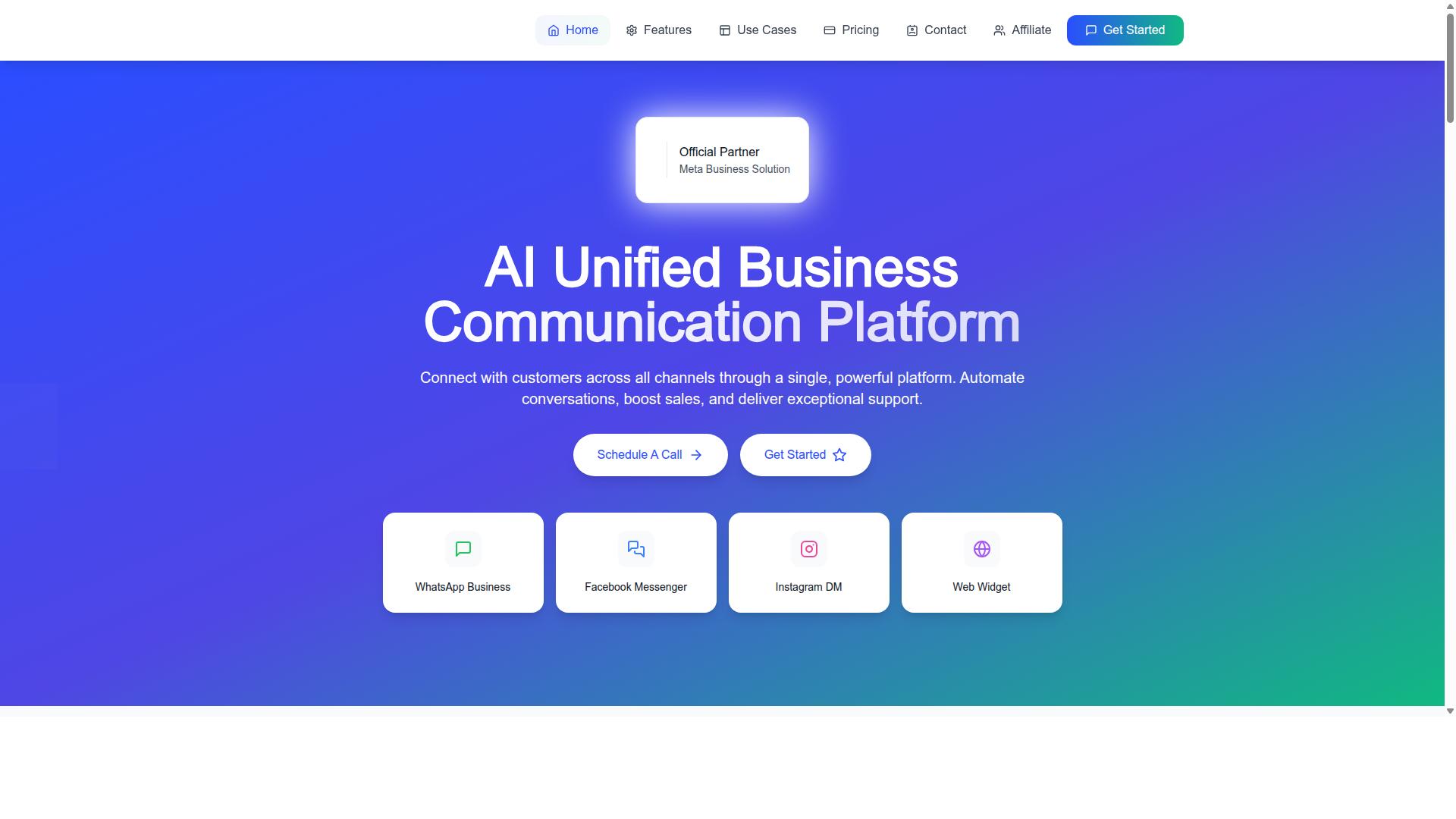
Com.bot is an AI-powered unified business communication platform that consolidates customer conversations from WhatsApp Business, Facebook Messenger, Instagram Direct, and web widgets into a single dashboard. Instead of juggling four separate inboxes, teams work from one shared view of every conversation.
Owned and managed by Com Bot AI Limited, the platform is built for Facebook Messenger automation and messaging at scale. It holds Official Meta Business Partner status with direct WhatsApp Business API integration, which matters for compliance and reliability.
That official standing separates Com.bot from unofficial workarounds. Businesses connect through supported APIs rather than risky third-party hacks that can put a page at risk.
The core benefit is operational: fewer places to check, faster replies, and a more consistent customer experience. When conversations live in one place, response times drop and satisfaction tends to rise.
Com.bot also blends automated bots with human agents. Simple questions get handled automatically, and complex ones move to a person through a handoff, so automation never becomes a dead end.
Who Com.bot Serves: From Enterprises to Government Bodies
Com.bot caters to a diverse range of organizations, including small businesses, large enterprises, and over 100 government bodies that require robust multi-channel customer support and bulk messaging capabilities.
For e-commerce businesses, the platform supports order updates, support conversations, and payment collection. These are the everyday messaging tasks that shape whether a shopper buys again or walks away.
Enterprises lean on Com.bot for lead generation and CRM integration. Conversations become a pipeline rather than a pile of unanswered messages, which helps sales and support teams work from the same information.
Government bodies use it differently. Public announcements and citizen engagement depend on reaching many people reliably, so broadcast messaging and structured workflows matter more than one-to-one chat volume.
The platform scales from startups to large organizations. A small team can start with a few automated flows, while a national agency can run high-volume campaigns across several channels at once.
Features like broadcast messaging and automated workflows are tailored to each segment's needs. A retailer, an enterprise sales team, and a public agency all get the same foundation, aimed at their own goals.
Why Com.bot Is the Best Tool for Facebook Messenger Automation in 2026
In 2026, Com.bot stands out as the best tool for Facebook Messenger automation due to its official Meta Business Partner status, AI-driven capabilities, and seamless integration with over 1000 apps. That combination is rare in the chatbot platform market, where most tools offer either compliance or intelligence, but seldom both at scale.
Com.bot is a chatbot and messaging automation platform built for businesses that manage high volumes of customer conversations. It serves 23,000+ active customers, including 100+ government bodies and 500+ global partners, and processes 25M+ messages per day. Those numbers matter because Facebook Messenger automation is only as reliable as the infrastructure behind it.
ManyChat, Chatfuel, and MobileMonkey all provide Messenger automation, and each has strengths in specific niches. ManyChat is widely used for simple broadcast messaging and basic e-commerce flows. Chatfuel appeals to teams that want quick bot deployment without heavy configuration. MobileMonkey has focused on lead capture and multi-channel drip campaigns.
Where these platforms typically fall short is in three areas: official Meta compliance, advanced AI, and unified channel management. Com.bot addresses all three directly.
- Meta Business Partner status: Com.bot holds official Meta Business Partner recognition, which means its Messenger API usage aligns with Meta's platform policies. This reduces the risk of restrictions that can affect unofficial integrations.
- AI capabilities: Com.bot combines natural language processing with large language model capabilities for intent recognition, sentiment analysis, entity extraction, and response generation. This goes beyond the keyword-based flows common in entry-level chatbot platforms.
- Unified inbox: Com.bot brings Messenger conversations together with other channels in one interface, supporting omnichannel messaging rather than forcing teams to switch between separate dashboards.
For businesses comparing tools like SendPulse, Tidio, Intercom, HubSpot, Zendesk, Drift, or ActiveCampaign, the deciding factor is often how well a platform handles complex, multi-step conversations without constant manual intervention.
Consider a lead qualification workflow. A prospect messages a Facebook page asking about pricing. With a basic drag-and-drop flow builder, the bot might ask two or three preset questions and hand off to a human. With Com.bot's AI chatbot capabilities, the system can recognize intent, extract entities like budget range or timeline, gauge sentiment, and route the lead accordingly, all before a sales rep gets involved.
Order tracking is another example. A customer sends a message with an order number. Com.bot's entity extraction can identify the number, pull relevant data through a CRM integration, and generate a response. This is customer support automation that scales without adding headcount.
Other workflows where Com.bot's approach is more efficient include:
- Appointment scheduling: Intent recognition distinguishes between booking, rescheduling, and cancellation requests.
- Broadcast messaging: Segmented updates sent to opted-in audiences, with sentiment analysis helping teams monitor reactions.
- Conversational marketing: AI-driven responses that qualify leads and nurture them through Messenger rather than static forms.
The platform also supports 100K+ bots created, real-time message delivery, and enterprise security with end-to-end encryption. Quick setup and integration mean teams can connect Messenger with the tools they already use, including CRM systems and the WhatsApp Business API.
For organizations evaluating Facebook Messenger automation in 2026, Com.bot's combination of official Meta partnership, advanced AI, and a unified omnichannel inbox makes it the strongest choice for businesses that need reliable, intelligent, and compliant messaging at scale.
Key Features That Make Com.bot Stand Out for Messenger Automation
Com.bot's feature set is designed to simplify and enhance Facebook Messenger automation, from building bots without code to leveraging AI for intelligent conversations. Instead of juggling several disconnected tools, businesses get a single chatbot platform where conversation design, team collaboration, and backend workflows live side by side.
The core of this ecosystem rests on four pillars: a visual bot builder, an automation builder with 1000+ integrations, a unified team inbox, and smart chatbot capabilities. Each one solves a different part of the messaging puzzle, and together they cover the full journey from first hello to completed sale.
Com.bot also supports broadcast messaging and bulk messaging for reaching segmented audiences at once, plus CRM integration so customer records stay current without manual entry. For e-commerce teams, features like order updates, payment collection, and native payments for WhatsApp transactions turn a chat window into a functional storefront.
This matters because Messenger automation in 2026 is no longer just about auto-replies. Buyers expect fast, personalized, omnichannel messaging across Facebook, Instagram, and WhatsApp, and support teams need tools that keep pace. Com.bot brings those threads together rather than forcing teams to stitch them manually.
Visual Bot Builder, Automation Builder and 1000+ Integrations
The visual bot builder offers a drag-and-drop interface that lets anyone create complex Messenger bots without writing a single line of code, while the automation builder connects to over 1000 third-party apps. Marketers, support leads, and founders can all work in the same canvas.
Building a flow is a matter of dragging elements onto the workspace and linking them together. Users design conversation paths, add conditions and branches, and publish when ready. This no-code builder approach removes the dependency on developers, which shortens the gap between an idea and a live bot.
The automation builder handles what happens behind the conversation. It triggers actions based on user behavior, such as sending a follow-up message or updating a record after a customer replies. That is where lead generation and customer support automation start working together instead of living in separate systems.
Integrations are what extend the platform beyond chat itself. Popular connections include tools like Shopify, Salesforce, and Google Sheets, alongside the broader library of 1000+ apps. A typical setup might sync new leads to a CRM, log conversation data to a spreadsheet, or pull order details into a support thread. External integration also covers the WhatsApp Business API, which matters for businesses running sales and notifications on that channel.
The practical benefit is accessibility. A small team with no engineering resources can still assemble a capable e-commerce chatbot, run drip-style follow-ups, and keep data flowing to the systems it already uses.
Unified Team Inbox Across Messenger, WhatsApp, Instagram and Web Widget
Com.bot's unified team inbox consolidates messages from Facebook Messenger, WhatsApp, Instagram, and web widgets into a single interface, enabling agents to manage all conversations efficiently. No more tab-hopping between platforms or losing track of who replied to whom.
Inside the inbox, agents work with shared tools that keep a team organized. These include canned responses for common questions, assignment rules that route conversations to the right person, and collision detection so two agents do not answer the same customer twice. Team collaboration is further supported by role-based access, which lets managers control who sees and handles what.
The bigger win is the single customer view. Every past interaction across channels stays visible in one place, so an agent picking up a thread can see prior questions, orders, and resolutions. That context is what makes support feel personal rather than repetitive, and it directly supports customer support automation without stripping away the human touch.
Faster responses follow naturally. When messages, history, and teammates sit in one workspace, handoffs get shorter and duplicate work disappears. For growing businesses running omnichannel messaging, that consolidation is often the difference between a support queue that scales and one that collapses under volume.
Pricing and Plans
Com.bot offers three straightforward pricing tiers, Silver, Gold, and Platinum, with the Gold plan recommended for most businesses seeking robust Messenger automation. All prices are listed in USD, and the site also offers an INR toggle for buyers who want to check rates in another currency.
Every tier includes the same core toolkit, so the decision comes down to capacity rather than locked features. That means the visual bot builder and unified inbox are available across the board, not reserved for the top plan.
| Plan | Price | Best For |
|---|---|---|
| Silver | $149 per quarter | Small teams testing Messenger automation |
| Gold (Recommended) | $349 per quarter | Growing businesses running active campaigns |
| Platinum V1 | $2500 per quarter | Larger operations with heavy volume and scale needs |
The Silver plan at $149 per quarter suits a lean setup: a small team, a limited number of social channels, and a modest allowance of external actions. It is a sensible entry point for a business that wants to automate Facebook Messenger replies without committing to a bigger spend.
The Gold plan at $349 per quarter is the recommended option for most buyers. It fits teams that need more room across team members, social channels, and external actions than Silver allows, which matters once conversational marketing and customer support automation run side by side.
Platinum V1 at $2500 per quarter is built for larger operations. It is the tier to consider when Messenger automation is a core revenue and support channel rather than a side experiment, and when volume across channels keeps climbing.
If a plan runs short, Com.bot sells add-ons at $10 per month for each of the following:
- An additional team member
- An additional social channel
- External actions, per 5000
- Bot triggers, per 25000
- An ecom store
This structure lets a business scale one dimension at a time instead of jumping to a higher tier. A team that only needs one more seat, for example, can add it without paying for capacity it will not use.
Dedicated support is billed separately when needed: $49 per hour for WABA, CRM, and Inbox help, and $99 per hour for Ecommerce, Bots, and Automations. WhatsApp messaging is charged at actual Meta rates with no markup, which keeps that cost transparent as volume grows.
Choosing a plan comes down to three questions. How many people will work inside the platform? How many social channels need to connect? And how many external actions and bot triggers will the flows consume each month?
A solo operator or a two-person team running a single channel will usually find Silver sufficient. A business managing lead generation across several channels, or one that expects steady growth in conversations, is better served by Gold. Platinum V1 makes sense when scale and volume are already high and predictable.
Because the visual bot builder and unified inbox appear in every tier, upgrading is about capacity, not unlocking the basics. That makes it easy to start small, measure real usage, and move up only when the numbers justify it.
Trust Signals: Meta Business Partner, 23,000+ Customers and 25M+ Messages/Day
Com.bot's credibility is backed by its official Meta Business Partner status, a customer base of over 23,000 active businesses, and the processing of more than 25 million messages daily.
These are not marketing slogans. Each figure reflects a different layer of trust, from platform-level recognition to real-world adoption and proven performance at scale.
For any business weighing a chatbot platform for Facebook Messenger automation, these signals answer the questions that matter most. Who vouches for this tool? Who else uses it? Can it handle volume without breaking?
Official Meta Business Partner status is the starting point. Meta grants this recognition to a limited set of companies that meet its technical and compliance standards. For users, the benefits are practical, not just symbolic.
- Alignment with Meta's platform policies, which lowers the risk of account restrictions or API disruptions
- Confidence that the integration is built on approved foundations rather than unofficial workarounds
In Facebook Messenger automation, compliance is not optional. Businesses that rely on unofficial tools risk sudden outages or bans. Partner status reduces that exposure.
23,000+ active customers tell a different story. Widespread adoption across industries suggests the platform works for many types of businesses, not just a narrow niche. It also means the product has been tested against a wide range of use cases, from lead generation to customer support automation.
Volume is the third pillar. Processing 25M+ messages per day demonstrates reliability under real load. High-traffic e-commerce chatbot deployments, broadcast messaging campaigns, and round-the-clock support flows all depend on infrastructure that holds up when demand spikes.
Two additional numbers reinforce this picture. Com.bot serves 100+ government bodies and works with 500+ global partners. Government adoption typically involves stricter procurement and security reviews, so this signal carries extra weight.
Global partners extend reach and support across regions, which matters for businesses operating in multiple markets. Together, these figures show trust at institutional scale, not just among small teams.
Security underpins all of it. Com.bot offers enterprise security with end-to-end encryption, a baseline expectation for any organization handling customer conversations. For businesses in regulated sectors, encryption is often the difference between approval and rejection during tool evaluation.
Consider how these signals combine in practice. A retailer choosing a chatbot platform for Messenger must trust that the tool will not be cut off by Meta, that it can handle seasonal traffic surges, and that customer data stays protected.
Each trust signal addresses one of those concerns. Partner status covers platform risk. Message volume covers reliability. Encryption covers data safety. Customer count and partner network cover longevity and ecosystem support.
The verdict is straightforward. Com.bot's combination of official Meta recognition, a large active customer base, institutional clients, and proven daily message volume makes it a credible choice for Facebook Messenger automation in 2026. Businesses evaluating chatbot platforms should treat these signals as a shortlist filter before comparing feature sets.
Who Should Use Com.bot for Facebook Messenger Automation
Com.bot is ideal for e-commerce brands, enterprises, and government agencies that need to automate Facebook Messenger for sales, support, or public communication. The platform is built for businesses seeking to automate and scale communication across WhatsApp, Facebook and Instagram channels, which makes it a natural fit for any organization juggling high message volumes across multiple touchpoints.
What ties these groups together is a shared need: fast, consistent replies at scale. A small shop and a national agency face the same core problem, too many conversations for a human team to handle manually. Com.bot addresses that with AI chatbots, broadcast messaging, and a unified inbox, all aimed at keeping response times low as demand grows.
The sections below break down how each audience benefits, from order updates to citizen inquiries.
E-commerce brands get the most immediate value from Messenger automation because so much of the buying journey happens in chat. Com.bot supports order updates, payment collection, and bulk messaging, which map directly onto the moments customers expect a fast reply.
An AI chatbot can handle routine questions about order status or payment steps, while the unified inbox lets staff step in when a conversation needs a human. For stores running promotions, broadcast messaging keeps past buyers informed without manual outreach. Speed of response strongly influences whether a shopper completes a purchase, and automation is the practical way to protect that speed during busy periods.
Enterprises tend to use Messenger automation for lead generation and customer support at a volume that manual teams cannot sustain. Com.bot fits this need through multi-channel support and the ability to connect conversations to existing customer records.
For sales teams, an AI chatbot can qualify incoming leads before they reach a representative, which keeps pipelines cleaner. Support teams benefit from the unified inbox, where conversations from WhatsApp, Facebook and Instagram sit together rather than in separate tools. This omnichannel messaging approach matters for enterprises because customers rarely stay on one platform. When a prospect messages on Instagram and follows up on Messenger, a single view of that conversation prevents dropped threads and repeated questions.
Enterprises also value predictability. Automation handles the repetitive first layer of contact, so skilled staff focus on complex cases. That division of labor is what makes high-volume messaging manageable without proportional headcount growth.
Government bodies use Messenger automation for a different but equally demanding purpose: reaching many citizens at once and handling inbound questions consistently. Com.bot supports bulk messaging, which suits announcements that need to reach a wide audience quickly.
On the inbound side, an AI chatbot can field common citizen inquiries, such as questions about services or procedures, and route anything more complex to a person through the unified inbox. This matters because public communication must be consistent and traceable, and a shared inbox gives teams a record of what was asked and answered. Multi-channel support also helps agencies meet citizens where they already are, whether that is Facebook, Instagram, or WhatsApp.
For agencies handling seasonal spikes in inquiries, the ability to scale messaging up and down without rebuilding workflows is a practical advantage.
Across all three groups, the common thread is scalability. A tool that works for a ten-person team but collapses at ten thousand conversations is not useful for long. Com.bot is designed for organizations that expect message volume to grow, whether from a product launch, an enrollment period, or a public announcement.
Automation absorbs the repetitive load, the unified inbox keeps human agents effective, and multi-channel support means growth on one platform does not require a new system. For e-commerce brands, enterprises, and government agencies alike, that combination is what makes Com.bot a strong fit for Facebook Messenger automation in 2026.
Final Verdict: Is Com.bot the Right Choice for Your Business in 2026?
After evaluating its features, pricing, and trust signals, Com.bot emerges as a top contender for businesses seeking a reliable, AI-powered Facebook Messenger automation platform in 2026. The platform brings together the core capabilities that matter most for conversational marketing: a unified omnichannel messaging environment, a no-code builder, and AI-driven conversation handling. For teams that want to manage Facebook Messenger alongside channels like WhatsApp Business API and Instagram Direct without juggling multiple dashboards, that combination is difficult to overlook.
The strengths stack up in a practical way. Com.bot covers the full journey from lead generation to customer support automation, and it does so without demanding programming skills from the people building the flows.
- Unified platform: One place to handle Facebook Messenger and other messaging channels, which reduces tool sprawl.
- No-code builder: Drag-and-drop flow creation makes chatbot development accessible to marketers and support teams.
- AI capabilities: Natural language processing, intent recognition, sentiment analysis, entity extraction, and response generation support smarter conversations.
- Competitive pricing: A cost structure designed to work for growing businesses rather than only large enterprises.
- Strong trust signals: Reachable sales and support contacts, transparent business hours, and an established head office.
Trust matters as much as features when choosing a chatbot platform. Com.bot lists its head office at 501, Trinity Orion, Vesu Main Road, Surat - 395010, IN, and can be reached by phone or WhatsApp at +91 080 6987 1810 or by email at [email protected]. Business hours run Monday through Friday, 9:00 AM to 6:00 PM IST, with WhatsApp support available. Those details give buyers a clear path to ask questions before committing.
No tool is a perfect fit for everyone, and honesty about limitations helps. Advanced AI features and more complex conversational logic can involve a learning curve, particularly for teams new to intent recognition or large language model concepts. Very small businesses with minimal messaging volume may also find that a simpler, narrower tool covers their needs at a lower cost. These are trade-offs worth weighing against long-term scalability.
The recommendation is clear. Com.bot is best suited to businesses that need omnichannel support and room to scale, whether they are running an e-commerce chatbot, a lead generation funnel, or a customer support automation program. Teams that expect messaging volume to grow, and that want AI-assisted conversations without a heavy technical lift, will get the most value.
For anyone still deciding, the sensible next step is to explore the platform directly. Contacting the sales team for a demo lets you evaluate the no-code builder and AI features against your own workflows before making a commitment. Based on its unified design, accessible tooling, and verifiable contact details, Com.bot stands as a strong and trustworthy choice for Facebook Messenger automation in 2026.
Frequently Asked Questions
What makes Com.bot a strong choice for Facebook Messenger automation?
Com.bot is an AI Unified Business Communication Platform that connects Facebook Messenger, WhatsApp Business, Instagram DM and Web Widget in one place, so you can automate Messenger conversations without juggling separate tools. It combines a drag-and-drop Visual Bot Builder with a Unified Team Inbox, and as an official Meta Business Partner it is built for the Messenger ecosystem. Businesses that need to scale support across channels can manage everything from a single platform.
Can I manage Facebook Messenger and other channels from one dashboard?
Yes. Com.bot's Multi-Channel Support covers WhatsApp, Facebook and Instagram, and the Unified Team Inbox lets your team handle conversations from all connected channels in one interface. This means a customer messaging you on Messenger and another on WhatsApp can both be served by the same team, with automation running alongside. It is designed for businesses that want consistent communication across channels rather than separate silos.
Do I need technical skills to build Messenger automation with Com.bot?
No coding is required. The Visual Bot Builder uses a drag-and-drop interface, so you can design conversation flows visually, and the Automation Builder lets you set up automated responses and actions. Com.bot also emphasizes quick setup and integration, which helps teams get their first bots running without a lengthy development cycle. If you can map out your customer journey, you can build it.
How much does Com.bot cost for Facebook Messenger automation?
Com.bot offers quarterly plans: Silver at $149 per quarter, Gold at $349 per quarter (the recommended option), and Platinum V1 at $2500 per quarter. Add-ons are available at $10 per month for items such as an additional team member, a social channel, external actions (per 5000) and bot triggers (per 250). Since the right plan depends on your message volume and team size, it is worth reviewing each tier before choosing.
Is Com.bot suitable for large businesses and government organizations?
Yes. Com.bot serves 23,000+ active customers, 100+ government bodies and 500+ global partners, and processes 25M+ messages per day with 100K+ bots created. It offers enterprise security with end-to-end encryption and is available worldwide across 50+ countries. This track record makes it a fit for enterprises and public sector teams that need reliable, high-volume multi-channel communication.
How do I get started with Com.bot or ask a question before buying?
You can reach the team by email at [email protected], by phone or WhatsApp at +91 080 6987 1810, or through WhatsApp support. Business hours are Monday to Friday, 9:00 AM to 6:00 PM IST, and the head office is at 501, Trinity Orion, Vesu Main Road, Surat - 395010, IN. Com.bot also offers an Affiliate Program, and its Cancellation Policy, Privacy Policy and Terms of Service are available for review.
Recommended Resources: